


LLM SEO is work intended to improve how a business appears in language-model answers. For ChatGPT Search, that means making useful pages accessible to search, answering real buyer questions and investigating the sources the product uses for those questions.
ChatGPT Search can return citations. OpenAI documents both web search and source links. A model response without citations, or an API capture that omitted them, tells you about that particular run. It doesn't establish what ChatGPT Search can do. [1]
For founders and marketing leads, I'd begin by separating three questions: does the answer name your business, does it link to a relevant page, and does it actually recommend you for the buyer's need?
Why separate mentions from recommendations?
A mention establishes that a name appears in the text. A recommendation requires reading what the answer says about that name. Named first is a useful position measure, but the first name could be background context or an option the answer rejects.
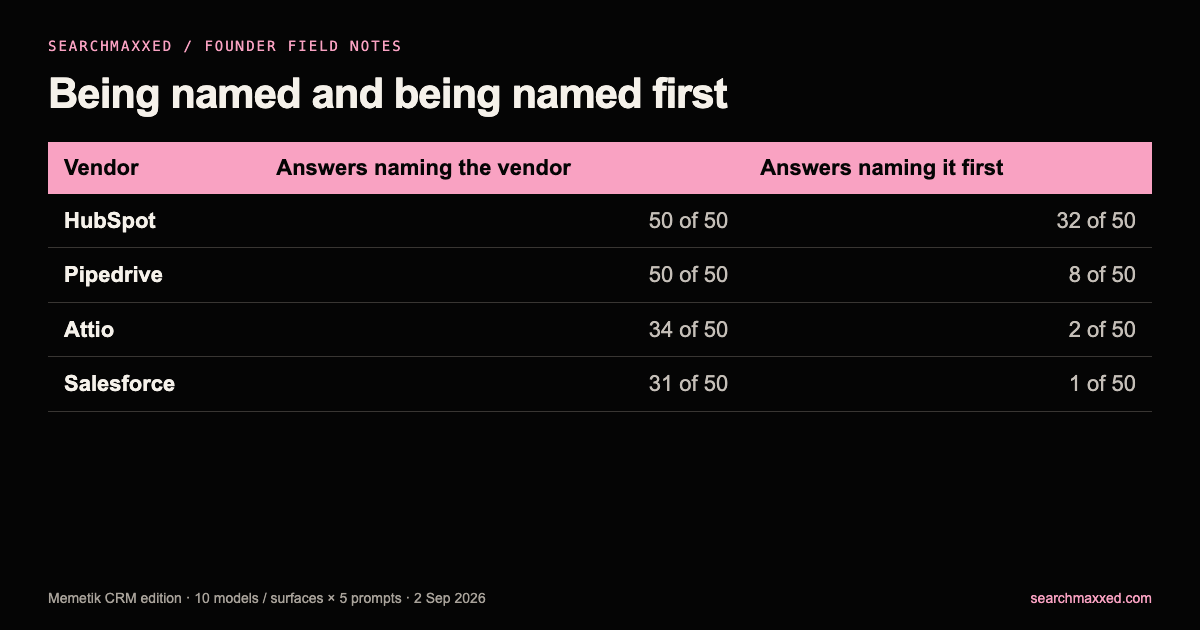
Memetik, our Searchmaxxed publication, provides a concrete example. Its September 2026 startup CRM edition recorded 50 answers across 10 models or answer surfaces using 5 fixed prompts. The data was collected on 2 September. [2]
| Vendor | Answers naming the vendor | Answers naming it first |
|---|---|---|
| HubSpot | 50 of 50 | 32 of 50 |
| Pipedrive | 50 of 50 | 8 of 50 |
| Attio | 34 of 50 | 2 of 50 |
| Salesforce | 31 of 50 | 1 of 50 |
HubSpot and Pipedrive appeared in the same number of answers, yet their named-first counts differed. A report containing only “mentioned in every answer” would conceal that distinction.
These are descriptive counts from one category and one edition, with one answer per prompt-and-model pair. They don't rate the software, establish a lasting position or prove which marketing activity caused a name to appear.
What does “rank in ChatGPT” actually mean?
I'd ask the buyer to name the outcome they want. “Rank” could mean a linked citation, inclusion in a comparison, being named first or a favourable recommendation.
Each is measurable under recorded conditions. None is a permanent position comparable to a fixed place on a results page. The question, product mode, date and conversation context can change the answer.
| Outcome | What to save |
|---|---|
| Mention | Exact answer text and the matched brand name |
| Citation | Displayed source link and the passage it supports |
| Named first | First tracked name under the stated counting rules |
| Recommendation | The sentence selecting the brand and the buyer need |
| Referral | A visit or conversion record, with attribution limits |
Define the target before commissioning content. A citation to an educational guide can be valuable, but it doesn't automatically mean the model recommends the company that wrote it.
Can ChatGPT Search reach the page?
OpenAI uses OAI-SearchBot for its search features. Its crawler documentation distinguishes that from GPTBot, which relates to content that may be used for model training. The settings are independent: a publisher can permit search access while declining training access. [3]
I'd check robots.txt, the CDN and actual request behaviour. Then confirm the page serves successfully and that the useful content is readable. A crawler rule alone doesn't prove that a page has been retrieved or selected.
For Google AI Overviews and AI Mode, Google's guidance requires an indexed page eligible for a snippet. The same foundational SEO practices apply. [4] These are different products with different controls, so I keep their access checks separate.
Which page should you improve first?
Choose a question close to a decision your customer has to make. The page should answer that question accurately enough that a person could act on it.
For a service business, that might be suitability, pricing factors, location coverage or a comparison with another approach. For software, it might be a workflow, integration requirement or migration decision.
Open the current sources for the question and compare their useful content with yours. Identify the actual gap. If your page explains the service but omits eligibility, answer eligibility. If the comparison lacks a stated method, write the method. A clearer heading helps a reader, but it can't supply evidence that the page doesn't have.
The AI SEO guide gives the website checks I'd complete before a wider rewrite.
How do you investigate the sources already being cited?
Save the URLs displayed for a fixed set of buyer questions and read the pages. Classify them by who controls them and what they contribute.
| Source type | What I would investigate |
|---|---|
| Your own website | Missing facts, weak explanations or access problems |
| Independent comparison | Selection criteria and whether you genuinely qualify |
| Review platform | Accurate profile details and real customer feedback |
| Video or interview | A demonstration or explanation worth producing |
| Documentation | Technical detail needed to answer the question |
In Memetik's CRM edition, youtube.com was the most frequently cited host in the recorded citation data, with 71 occurrences. Attio's domain appeared 39 times. The method excludes citation data from the ChatGPT capture because that API output returned no citations, and resolves Gemini redirects before counting hosts. [2]
The counts help identify sources worth reading. They don't establish that every company should make videos or that publishing on one domain guarantees a recommendation. A useful source investigation ends with a specific page and a legitimate way to contribute.
How would I set up a baseline?
Start with real customer language from sales calls, support requests or search data. Include different buying needs rather than five paraphrases of the same question.
Record the exact prompt, model or product surface, search setting, language, market and date. Use clean sessions where possible and note the conditions you cannot control. Save complete answers and displayed citations.
Run more than one observation before treating a change as persistent. For an ongoing programme, keep a stable question panel and repeat it across a declared window. Report the number of observations and any model or method change beside the result.
The first collection is useful for choosing work. A single answer is too unstable to support a broad success claim.
How do you know whether a content change helped?
Keep the earlier observations and record the release date. Repeat the same questions under comparable conditions and review the answers against the same counting rules.
Track unchanged questions or pages as a comparison where practical. If every brand's citation count moves together, the platform or collection method may explain the shift. If only a related set of questions changes after a page release, investigate that pattern before claiming causation.
Watch site visits and enquiries separately. Citation growth, referral growth and revenue growth are different outcomes. The report should show which ones you actually observed.
Where would I start if a competitor keeps appearing?
I'd take one buyer question and trace the competitor's appearance back to the displayed sources. Then I'd choose the highest-value gap we can fix: the owned page, a missing fact, an outdated profile or a third-party page where the business deserves inclusion.
At Searchmaxxed, the Source Layer and Managed Search Loop connect that investigation to implementation. I want the report to end with a page to improve and a reason for improving it.
If you want our team to own that work, send us your market and website. If you're building the measurement yourself, start with Memetik's published method and keep the exact answers behind every count.