


SEO still deserves investment when search connects a business with customers it can serve profitably. The decision in 2026 is which searches offer that opportunity and which pages earn enough business to justify the work.
Before Searchmaxxed, I built Radiant Roof Repairs from zero to more than A$1 million in annual revenue with SEO as its only marketing channel. Three high-intent Gold Coast roofing searches reached number one within 90 days. That experience is why I start with the buying decision and the market. The Radiant case study is a historical result, not a forecast for another business.
AI answers add another place to investigate. They don't tell you, on their own, whether your next customer will come from a map, an organic result, a cited source or a direct visit after seeing your name.
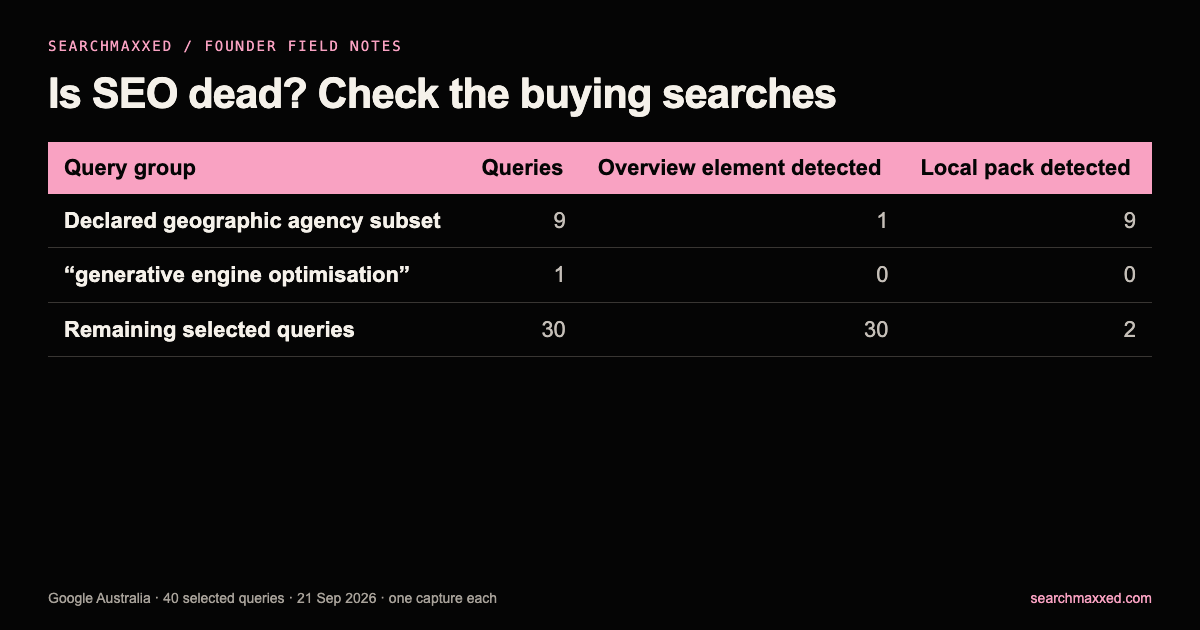
What did our current search check show?
On 21 September 2026, we captured 40 selected SEO-related queries through DataForSEO's Google Australia desktop endpoint. The set included agency searches, definitions and practical AI-search questions. Each query was captured once.
The capture flagged an AI Overview element for 31 queries. Sixteen returned source lists. Fifteen flagged an Overview without returning references in the saved extract. Nine had no Overview element in the capture.
Those are observations about the returned search data. We didn't collect clicks, conversions or the full rendered answer for every query. I would not turn this snapshot into a claim that informational clicks have disappeared.
The useful finding is that the same query set contained several different result formats.
Scroll the table horizontally on smaller screens.
| Query group | Queries | Overview element detected | Local pack detected |
|---|---|---|---|
| Declared geographic agency subset | 9 | 1 | 9 |
| “generative engine optimisation” | 1 | 0 | 0 |
| Remaining selected queries | 30 | 30 | 2 |
The geographic subset was “seo agency australia”, “seo agency brisbane”, “seo agency sydney”, “seo agency melbourne”, “seo agency perth”, “seo agency gold coast”, “seo agency sunshine coast”, “seo sunshine coast” and “best seo agency brisbane”. Melbourne was the one query in that subset flagged with an Overview.
This is a selected sample of the SEO market. A retailer, clinic or software company needs its own query set. The saved capture includes the questions and method so you can inspect the grouping.
Why does the result format change the work?
A local pack makes the business profile and location evidence relevant to the buying path. An organic result makes the landing page and its click appeal relevant. An AI answer adds the question of which sources and businesses appear inside the response.
A business can need all three. I would choose the work from the searches buyers make before purchasing, then check the experience those searches actually produce.
| Search experience | Work I'd inspect first |
|---|---|
| Local pack | Business Profile accuracy, reviews, relevant services and location pages |
| Organic service results | Page relevance, indexing, competitors and enquiry flow |
| AI-generated answer | Page eligibility, cited sources and how the business is described |
| Product or shopping results | Product data, availability and the route to purchase |
The table is a planning aid. It doesn't claim that one change guarantees a position on any surface.
Does Google say ordinary SEO still matters?
Yes. Google's own guidance applies foundational SEO practices to AI Overviews and AI Mode. A supporting page must be indexed and eligible for a Search snippet. Google says there are no additional technical requirements. [1]
That gives a website team a concrete starting point: accessible pages, useful visible text, internal links and structured data that matches the page where it applies.
Google also describes query fan-out, where its AI features issue related searches while constructing an answer. A page can be relevant to one of those related searches without being the first result for the original wording.
How would I investigate falling organic clicks?
I'd first split the decline by page and query. A site-wide line can hide a service page gaining enquiries while an old informational article loses visits.
Then compare the periods. Check impressions, clicks and position in Search Console alongside seasonality, indexing changes and the actual results shown for the affected queries. Use analytics and enquiry records to understand the business effect.
An AI Overview appearing for a query is one possible explanation for a changed click pattern. A single screenshot cannot isolate that cause from ranking changes, demand changes or a weaker title.
I would also check the conversion path. A phone number that fails on mobile or an enquiry form that loses submissions can erase the value of useful traffic. Search work continues through the page a customer lands on.
Which content would I keep funding?
I'd keep funding pages that help a valuable buyer make a decision the business can fulfil. That could mean a service page, a comparison, a technical answer, a location page or a useful original study.
For each candidate, write down the customer question, the intended next action and the evidence only the business can contribute. Then check whether the site already has a page that should own that question.
A useful example is an agency comparison. The buyer needs differences in scope, implementation ownership, pricing and evidence. A longer introduction about AI changing marketing does little to help them choose. My AI SEO agency shortlist starts from those buying criteria.
I would hold a page if the only plan is to repeat an answer already covered well on the site. Publishing more competing pages makes it harder to know which one deserves links and updates.
What should the monthly report show?
The monthly report should let the owner connect what shipped with the observations that followed.
| Report item | Question it answers |
|---|---|
| Released work | Which pages or technical changes are live? |
| Indexing and search data | Can the new work be found, and for which queries? |
| AI-answer observations | Where was the brand mentioned or cited under recorded conditions? |
| Enquiries and sales | Did the business receive useful demand? |
| Next action | What does the evidence justify changing now? |
Keep the attribution limit beside a revenue number. A sale can involve several visits, referrals or earlier contact with the brand. A transparent report is more useful than assigning all of that value to the last visible click.
Is AI replacing the people who do SEO?
AI can accelerate parts of research, drafting and implementation. Someone still has to choose a valuable market, test the claims, approve the work and check the released page.
I want the person accountable for results to understand the website and the business. If a proposal offers a large content count, ask who decides which pages deserve to exist and who verifies them after publication.
At Searchmaxxed, the Managed Search Loop describes that cycle of measurement and implementation. The owner should be able to see the work that happened and the reason for the next change.
What would I do this month?
Choose one commercially important area of the site. Record the searches and questions its buyers use. Check the current results, the pages the site already has and the enquiry path.
Fix the most concrete problem first: a missing service answer, an indexing fault, a weak location page or an unusable form. Record the release date, then follow the relevant search and business measures through the next reporting period.
If that first investigation shows a useful market, fund the work against it. If it shows the wrong audience or poor economics, change the target. The decision can be made with evidence specific to your business.