


Key takeaways
Judge an SEO agency by what changes on your site and around it each month.
| Work area | What you should see |
|---|---|
| Technical SEO | Crawl, speed and duplicate-URL faults fixed |
| Keywords and pages | New or rebuilt pages for buying searches |
| Links and listings | Live links, mentions, reviews and citations |
| AI answers | Checks on what ChatGPT and Google's AI say |
| Reporting | Changes made, then rankings and enquiries |
If you already pay an agency, hold last month's report against this table. Any empty row is a fair question for your next call.
An SEO agency improves your website and your presence on other sites so you rank in Google and appear in AI answers. Each month you should see technical fixes, new or improved pages, links and listings, and a report that ties the work to enquiries. If the report is all that changes, you're paying for paperwork.
What does an SEO agency do each month?
An SEO agency's month should produce changes you can open and check: fixed faults, new pages, rewritten pages and links on other sites. Sprintlaw's legal guide for Australian SEO agencies lists the typical services as audits, on-page work, keyword research, content, link acquisition, technical fixes and reporting.[1]
That list gives you the categories. It doesn't tell you what a month should hold, and that's where agencies differ most.
Some agencies count inputs. Resurge Digital, a Brisbane agency, describes a typical retainer breakdown as "four hours spent blog writing, 80 key phrases, technical SEO implementation etc."[2]
We'd rather see outputs. Four hours of writing could produce a strong service page or a handful of thin posts, and the report would read the same either way. An output is something you can click: a new page, a fault that's gone from Search Console, a link on another site.
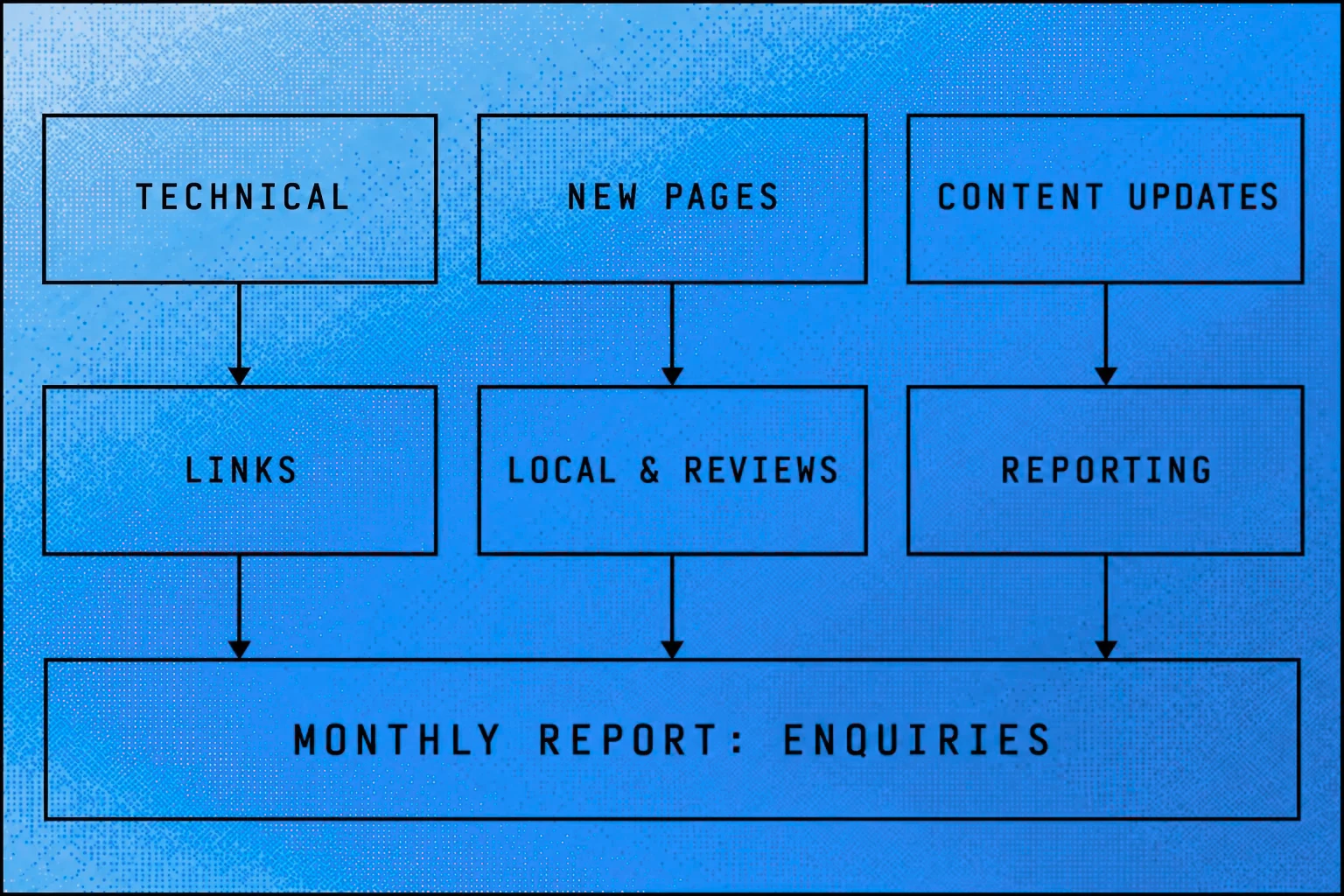
Most monthly SEO work falls into the streams below. The mix shifts with your business, but a month with none of them shipped deserves a question.
| Stream | How to check it yourself | Why it matters |
|---|---|---|
| Technical SEO | Run the page through URL Inspection in Search Console | Google has to read a page before it can rank it |
| New and rebuilt pages | Open each new URL in the report | Each buying search needs a page that answers it |
| Content updates | Compare the old and new versions of the page | Google favours original, people-first content |
| Links and mentions | Visit each linking page | Links help Google find and weigh your pages |
| Local listings and reviews | Look at your Business Profile and reviews | Reviews and listings confirm your business details |
| Reporting | Match enquiries to the pages that drew them | You see what the money did |
What should happen in the first month?
The first month should produce an audit, a written plan and the first fixes. An audit maps where you already appear and which buying searches you're missing. It also lists what's broken.
We've written a separate guide on what an SEO audit covers, so here's the short version of month one.
Google suggests a first check anyone can run. Search Google for site: followed by your domain. If your pages come back, you're in the index.[3]
Then the agency needs access to your Search Console, your analytics and your website. By the end of month one, you should hold a plan naming the searches, pages and fixes for the next 90 days. We'd also expect the worst technical faults fixed inside that first month, because every later page depends on them.
What technical SEO work should you see?
Technical SEO makes sure Google can reach, render and index your pages. A month of it looks like fixed crawl errors, cleaner redirects, one canonical URL per page and faster templates.
Rendering comes first. Google needs to reach the same CSS and JavaScript files your visitors' browsers load. If it can't, Google may not understand the page or rank it.[3] The URL Inspection tool in Search Console shows how Google sees any page.[3]
Duplicates come next. When the same content sits at several URLs, search engines pick one canonical URL to show.[3] Google recommends a redirect from the extra URLs, or a canonical tag where a redirect isn't possible.[3]
An XML sitemap lists the URLs you care about. Google calls it optional, so it belongs on the list but rarely at the top.[3]
We treat speed and mobile rendering as page-experience work. Google says its core ranking systems look to reward content that provides a good page experience.[4]
We'd put any live technical fault ahead of new content, because a page Google can't read can't rank. A healthy site needs less of this work over time. Expect a bigger push early, then a monthly check as new pages go live. Our technical SEO service covers Core Web Vitals, crawl and indexing, redirects, canonical tags, sitemaps, schema and mobile rendering.
How does keyword research turn into pages?
Keyword research finds the words your customers type, and the agency then builds or rebuilds one page for each buying search. The page is the deliverable; the keyword list is a working document.
People use different words for the same thing. Google's own example is that some people search for "charcuterie" and others for "cheese board".[3] Google also says its language systems can match a page to many queries without the exact words.[3]
So good research groups searches by what the person wants, then gives each group one page. Two pages chasing the same search compete with each other, and Google's guide calls duplicate pages a confusing experience for people.[3]
Here's what a month of keyword-led page work might look like for a roofing business. This is an example, not a case study.
- A new page for roof leak repairs.
- A roof restoration page for each suburb the business serves.
- The home page title rewritten around the main service and the region.
- Internal links from older blog posts to the new service pages.
Each page then needs the on-page basics. Google builds the title link in results partly from the page's title element, and says a good title is unique, clear and accurate.[3] A good meta description is short, unique to the page and covers its main points.[3] Link text matters too, because it tells people and Google what the linked page is about.[3]
Before Searchmaxxed, our founder built Radiant Roof Repairs from zero to more than $1 million a year in revenue using SEO as the only marketing channel. Three high-intent Gold Coast roofing searches reached number one within 90 days. He did the pages, research, competitor checks and updates manually.
Choosing which pages to build, and in what order, is the core of our content strategy work.
What makes agency content worth publishing?
Content earns its place when it tells the reader something the pages already ranking don't. Google's own guidance asks whether content provides original information, reporting, research or analysis.[4]
Google also says it has no preferred word count.[4] So a monthly quota of blog posts tells you little about the value of the work. The better use of those hours is rewriting the service pages that bring enquiries.
Updating counts as real work. Google's starter guide tells site owners to check published content and update it as needed.[3] It even suggests deleting content that's no longer relevant.[3]
Automation is the new risk. Google lists "using extensive automation to produce content on many topics" as a warning sign.[4] At Searchmaxxed, our rule is that publishing at scale only works when every page adds original information.
Trust carries the most weight. Google says trust matters most among experience, expertise, authoritativeness and trustworthiness, the qualities it calls E-E-A-T.[4] Its guidance also asks whether content shows first-hand expertise and whether it's clear who wrote it.[4]
How does an SEO agency earn links and mentions?
Link building gets other websites to mention and link to yours, which helps Google find your pages and weigh them. Google says it primarily finds pages through links from pages it has already crawled.[3]
Links still count, but they're one signal among many. Google says PageRank uses links and is one of its fundamental algorithms. It also says PageRank is one of many ranking signals.[3]
A month of link work should leave live links and mentions you can visit. Think of a supplier's partner page, a local news story, an industry directory or a podcast guest page.
Promotion can go too far. Google warns that you can overdo it, and that search engines may treat some practices as manipulation.[3] A report full of links from sites you've never heard of deserves a hard look.
Reviews, citations and directory listings belong in the same stream. They confirm the facts on your own pages, and AI answers cite lists and reviews on other sites too. Our link building work covers links, digital PR, brand mentions and directories.
What does local SEO work include each month?
Local SEO keeps your Google Business Profile, reviews, citations and listings accurate and active. It also adds service-area and suburb pages, and it tracks your Google Maps rankings.
Radiant Roof Repairs shows what a profile can carry. Its Google Business Profile showed 1,487 phone calls and 3,654 website visits. It also showed 31,000 views, and most of that activity came through Google Maps.
At Radiant, our founder treated the profile as seriously as the website and asked for a review after every job. A month of local work should show profile updates, new reviews, cleaner citations and new service-area pages.
How do AI answers change what an SEO agency does?
AI answers add a second job: making sure ChatGPT, Gemini, Perplexity and Google's AI Overviews describe your business correctly and name it. People call that work GEO, AEO or LLM SEO, and it builds on the same pages, facts and outside sources.
On 19 October 2026, Google Australia showed an AI Overview above the organic results for this exact search.
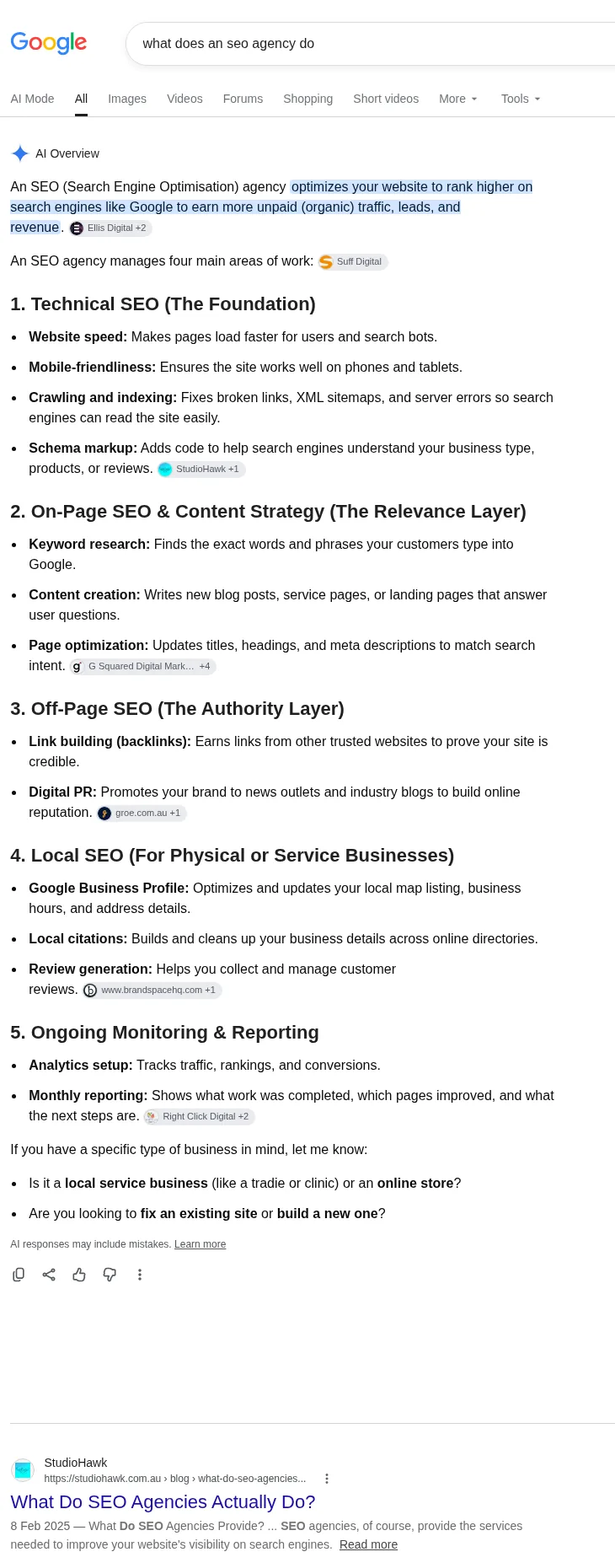
A page can rank first and still miss the AI answer sitting above it. Ranked results lean on relevance and links. AI answers lean on facts they can check and sources that agree with each other.
So the monthly work adds these jobs:
- Plain facts on your own pages about what you do, where, and for whom.
- Structured data that matches those facts.
- Outside sources that agree with them, such as reviews, directories and press.
- A monthly check of what ChatGPT, Gemini, Perplexity and Google's AI answers say about you.
How should an SEO agency report the work?
A monthly report should list what changed first, then show what earlier changes did to rankings, traffic and enquiries. Someone at the agency should be able to explain every line in plain words. Resurge Digital makes the same point: a good agency sends monthly reports it can explain in detail.[2]
Timing matters when you read a report. Google says some changes take effect within hours and others take several months.[3] It suggests waiting a few weeks before judging whether a change helped.[3]
That's why we like reports split in two: work shipped this month, and results from work shipped earlier. Mixing them hides months where nothing shipped.
Rankings and traffic are steps on the way. The number we care about is qualified enquiries, because that's what pays for the work. Search Console helps you monitor how you perform in Google Search, and GA4 tracks what visitors do once they land.[3]
Which signs show an SEO agency isn't doing the work?
The main warning sign is a report that changes every month while your website stays the same. Watch for these as well:
- Promises of page one. Google says there are no secrets that'll automatically rank a site first.[3] Sprintlaw's guide tells Australian agencies to avoid promises like "page one in 30 days" under the Australian Consumer Law.[1]
- Hours instead of outputs. A breakdown of hours spent tells you about effort, and nothing about what changed.
- Links you can't trace. If the agency can't show you where a link lives, you can't judge whether it helps or harms.
- Content by the tonne. Google's guidance warns against producing lots of content on many topics in the hope that some of it performs.[4]
- Unclear ownership. You should know who owns the site, the content and the data if you leave.
What does a month of SEO work look like at Searchmaxxed?
Searchmaxxed is an SEO and AI search agency for law firms, clinics, premium builders, cybersecurity firms and enterprises. We measure a month in page releases. A page release is an approved new page or a substantial rebuild.
Every client starts with a website built for search, then one of three monthly packages: Recognised, Recommended or Renowned (see what each includes). Content pace is the same in all three; what grows is the authority behind the work: backlinks, best-of list placements, press and how often we meet.
| Package | Page releases | Other monthly work |
|---|---|---|
| Recognised | Pages from your agreed topical map, with the whole map built within six months | Pages from your topical map, 4 backlinks a month, Google Business Profile management, AI answer tracking, and a monthly strategy call and report |
| Recommended | Pages from your agreed topical map, with the whole map built within six months | The same work with 10 backlinks and 2 best-of list placements a month, a press release each quarter, fortnightly calls and weekly reports |
| Renowned | Pages from your agreed topical map, with the whole map built within six months | The same work with 20 backlinks and 6 best-of list placements a month, a press release each month, and weekly calls and reports |
Every managed package also includes a 90-day plan broken into weekly releases and a monthly decision memo that measures the work against competitors. We wire and check Search Console and GA4, and you deal directly with the people doing the work, with no account managers. You own the site, the repository, the content and the data from day one.
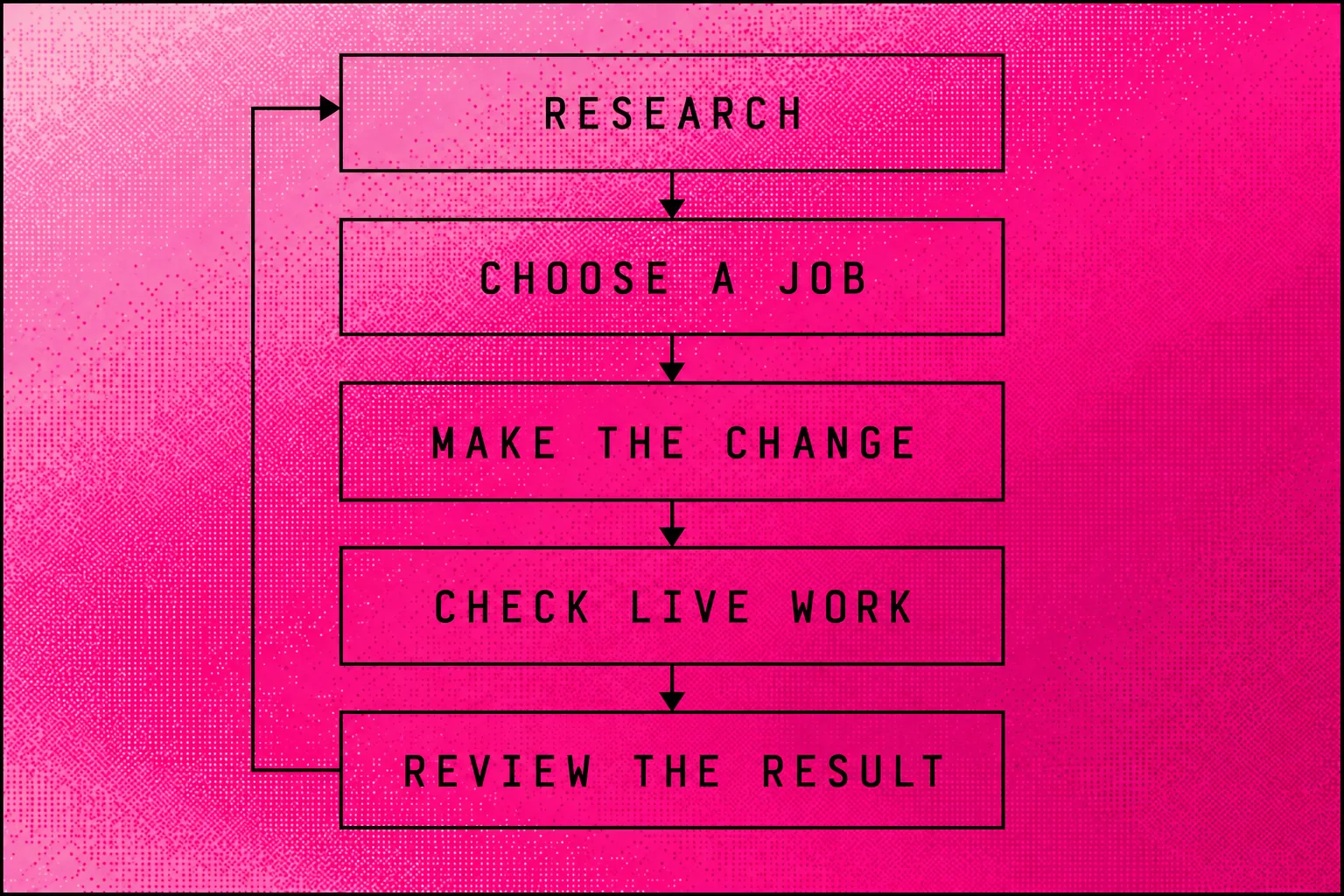
Here's how we choose each month's work:
- AI agents we build connect to your Search Console and GA4.
- They read the Google results, scrape competitors' sites and check what AI answers say about you.
- That data feeds our search process. It shows us which page, fix or link should bring in the most enquiries next.
- We build pages, fixes, schema and internal links on your website, which you own.
- We build links, reviews, citations, press and mentions through our off-page SEO.
- We check the live result, then read matched 28-day periods for monthly decisions and 90-day periods for direction.
What that gets you is a month aimed at enquiries. Our founder ran these same steps by hand at Radiant Roof Repairs. Searchmaxxed's work has generated more than $15 million in revenue through search for its clients.
Our SEO service sets out the full scope. No lock-in: 30 days' notice, no exit fee. Searchmaxxed quotes each business after a free growth plan and doesn't publish prices. Get your free growth plan.
Frequently asked questions
Is it worth hiring an SEO agency?
It's worth it when search can bring you customers and you'd rather pay for the work than learn it yourself. The test is whether the agency ships changes you can see each month. Search suits businesses that can wait a few months for results. If you need leads this month to survive, paid ads will serve you better first.
Is SEO dead now with AI?
No. Google's guidance, updated on 5 October 2026, still calls SEO a helpful activity when you apply it to people-first content.[4] The surface has changed, though. Google showed an AI Overview above the results for this same search, so the job now includes getting your facts into those answers.
How much does an SEO agency cost?
It depends on how much work ships each month. Resurge Digital notes that some agencies charge a flat monthly fee and others charge by the hour.[2] Compare quotes by output: the pages, fixes and links each one buys. Get your free growth plan.
What's the difference between an SEO agency and an SEO consultant?
A consultant mostly advises, while an agency advises and does the work. Settle one question before you sign: who builds the pages, fixes the faults and earns the links? If you have a developer and a writer in-house, a consultant's plan may be enough. If you don't, you need the agency.
How long does SEO take to show results?
Google says some changes take effect within hours and others take several months.[3] It suggests waiting a few weeks before judging whether a change helped.[3] Resurge Digital puts the general timeline for SEO results at six months or more.[2] At Radiant Roof Repairs, three high-intent Gold Coast roofing searches reached number one within 90 days. That was one business in one market, so treat it as an example rather than a forecast.
Can an SEO agency promise you page one of Google?
No honest agency will promise a position. Google says there are no secrets that'll automatically rank a site first.[3] Sprintlaw's guide tells Australian agencies to avoid promises like "page one in 30 days" under the Australian Consumer Law.[1] What an agency can commit to is the work: a scope, a monthly cadence and the changes it ships.
How often should an SEO agency report to me?
Monthly reporting is the usual rhythm, and someone should walk you through it. Resurge Digital says a good agency sends monthly reports it can explain in detail if asked.[2] At Searchmaxxed, a monthly decision memo measures the work against your competitors. You also get direct access to the people doing the work.
Should I sign a lock-in contract with an SEO agency?
Only sign a term you'd be comfortable living with if the work stalls. Resurge Digital notes that agencies don't always require lock-in contracts and may work month to month.[2] Sprintlaw reminds agencies that unfair terms in standard-form small business contracts can be void.[1] Searchmaxxed has no lock-in: 30 days' notice, no exit fee.
Who owns the website and content an SEO agency builds?
Whoever the contract names, so read the ownership clause before you sign. Sprintlaw advises agencies to set out IP ownership and licence terms so there's no doubt about who owns what.[1] At Searchmaxxed, you own the site, the repository, the content and the data from day one.
What access does an SEO agency need to start?
An agency needs access to your website, your analytics and Google Search Console, ideally in the first week. Search Console helps you monitor and improve how your site performs in Google Search.[3] Without website access, an agency can advise but can't ship fixes. If you rely on local customers, add the agency as a manager on your Google Business Profile.
Does an SEO agency write the content?
How is SEO different from paying for Google Ads?
Ads appear only while you pay. SEO builds pages that keep working after the spend stops. Resurge Digital describes ads as top results for as long as you pay for keywords, and SEO as longer lasting visibility.[2] Paid ads suit a business that needs leads this week, and SEO suits one that can build for the months ahead.
Sources
- Sprintlaw (Australian law firm; not an SEO competitor): Legal Considerations for SEO Marketing Agencies: Contracts and Compliance Guide
- Resurge Digital (Brisbane digital agency): Questions to Ask Your SEO Agency Before You Hire Them
- Google Search Central: Search Engine Optimization (SEO) Starter Guide
- Google Search Central: Creating helpful, reliable, people-first content
About the editorial team
Founder, Searchmaxxed