


An SEO audit identifies what stops people finding your business through search and gives you a plan to fix it.[1]
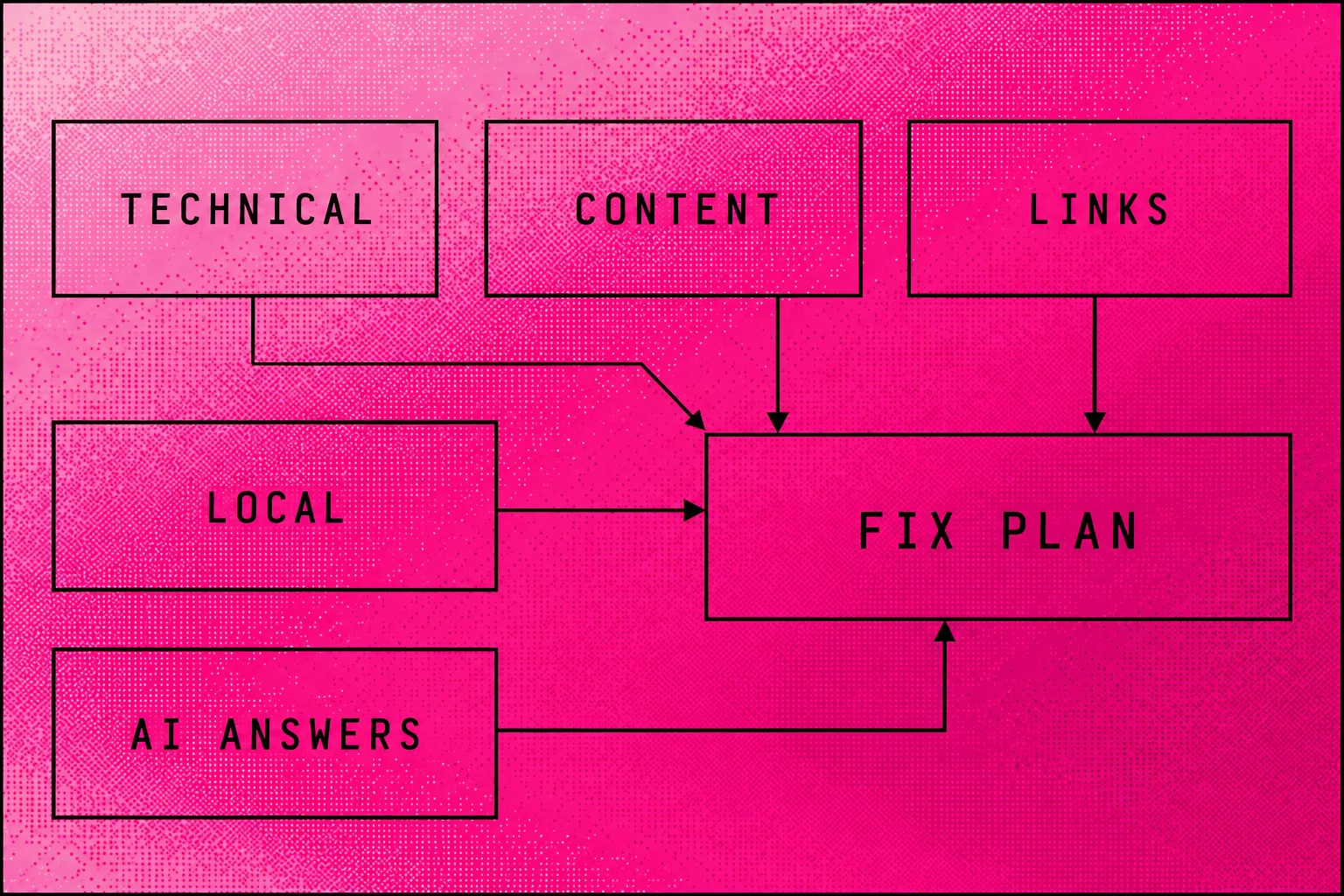
- Check technical SEO, content and links.[1] I'd add local profiles and AI answers when customers use those channels to choose you.
- Compare the scope: Lucky 44 includes fixes at $795 + GST; Digital Marketing Tribe's SEO audit starts at $1,200 + GST.[2][3]
- Give each fix an owner and a due date, then measure the change.[4][5]
An SEO audit is a review of your website's search performance that finds problems and sets priorities for fixing them.[1] It checks technical access, content and links against the searches you want to win.[1] For local businesses, I'd also check business profiles and AI answers before choosing the next job.
What is an SEO audit meant to check?
An SEO audit checks technical access, page answers and supporting links.[4][1] I would add local profiles and AI answers when customers use those channels to choose you.
Agree the scope before anyone starts. Ask which pages, locations and search platforms the auditor will cover. Ask what they need from you and what you will receive.
| Audit area | What I'd ask the auditor to check |
|---|---|
| Technical SEO | Access, indexing, redirects, canonicals, speed and mobile pages. |
| Content and on-page SEO | Search intent, page titles, accuracy, missing answers and internal links. |
| Links | Relevant external links, broken destinations and possible spam. |
| Local SEO | Business profile details, reviews, local listings and location pages. |
| AI visibility | Bot access, business facts, answers and the sources behind them. |
These are the five areas I would specify, with findings tied to affected pages or external records. A fault on a service page needs a different job from a wrong address in a directory.
Content and on-page SEO
A content audit reviews what each page says, whether it ranks and converts, and what should happen to it next.[4] PWD's process joins page URLs with Search Console, GA4 and link data before choosing whether to keep, update, merge, redirect or delete content.[4]
For a roofing business, I'd compare a roof-repair service page with the question a customer asks before booking. Does the page explain the repair, show relevant work and make contact easy? I'd check those gaps before ordering another blog post.
Ask for a reason behind each recommendation in your content strategy. Keep legal pages and pages that help customers decide, even when search traffic is low.[6]
Links and external records
Google discovers pages through links, and descriptive link text helps people and Google understand the destination.[7] Google also treats links created mainly to manipulate rankings as link spam.[8]
I'd ask the auditor to separate internal navigation faults from external link-building opportunities. Check where a link goes, what the source says about the business and whether the recommendation serves customers.
A list of referring domains needs interpretation. Ask which link needs repair and why, before approving a removal or a new placement.
What should a technical SEO audit checklist cover?
A technical SEO audit checks whether Google can discover, read and index your pages.[9][4] Google separates crawling, indexing and serving search results, so the audit needs evidence for each stage.[9]
Crawling means Google fetches a page.[9] Server problems, network faults and robots.txt rules can stop that access.[10] Ask the auditor to test the affected URL and identify the cause.
Rendering means Google processes the page, including its JavaScript.[11] Google may miss content when it cannot access the resources that produce it.[12] Compare the page a customer sees with Google's URL Inspection result.[13]
Indexing means Google analyses a page for its index.[9] A noindex instruction can prevent inclusion, and Google selects a canonical URL for similar content.[14][15] A canonical is the representative URL Google may show in results.[15]
Check the following before commissioning broader technical SEO work:
- Important pages open without a login or server error.
- Indexing instructions match the page's intended job.
- Redirects reach the correct replacement page.
- Internal links lead to live, relevant pages.
- Mobile pages show the main content and let you complete an enquiry.
- The auditor explains speed and Core Web Vitals findings in terms of the affected pages.
Treat this as a request for tests, not permission to change every setting.
An XML sitemap helps Google discover URLs; Google does not require one.[16] Duplicate content alone does not violate Google's spam policies.[17] Keep the distinction between a real access fault and an optional improvement.
An indexed page can still fail to appear for a particular search because its content does not match the query.[18] Technical fixes and page answers need separate decisions.
How do you audit local SEO and AI visibility?
Use two checks for local SEO and AI visibility: compare public business records and inspect the answers customers see. Agree the locations and questions before testing a business that serves a town or region.
Local SEO
Valve+Meter's checklist includes Google Business Profile optimisation and local citations for businesses serving specific areas.[19] Its off-page scope also covers reputation, directories and reviews.[20]
For a local SEO audit, ask someone to compare your website with your business profile and major listings. Check the trading name, phone number, services and real service area. Review the enquiry path from a local page through to a call or form.
Record a wrong address as a correction to a specific record. Record a missing service page as website work. Give each job to someone who can change it.
AI visibility
OpenAI says a site needs to allow OAI-Searchbot and its published IP addresses to become eligible for inclusion in ChatGPT search.[21] Eligibility does not ensure placement.[21]
Ask the auditor to check bot access before proposing a rewrite. Then save the exact question, platform, location, date and sources for each answer you inspect. Repeat the check before calling an absence a lasting pattern.
I'd separate three findings. Check whether the engine can reach the site, whether it gets a business fact wrong and whether it names another provider.
Answer engine optimisation and generative engine optimisation belong in the audit scope when AI answers matter to your customers. Our AI SEO explainer covers how we connect that work with Google search.
How much does an SEO audit cost?
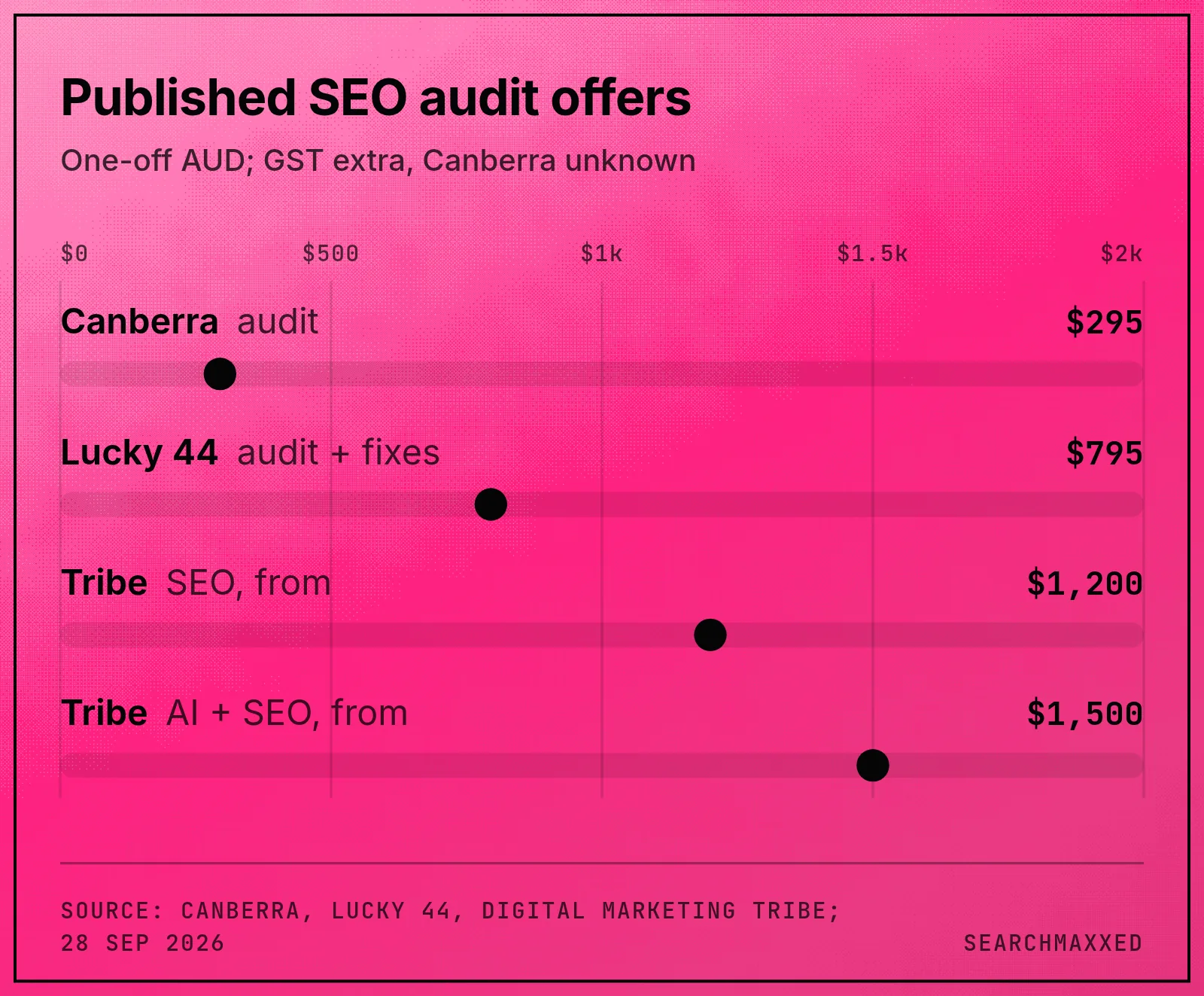
SEO Company Canberra publishes a $295 one-off audit.[22] Lucky 44 charges $795 + GST for an audit with fixes.[2] Digital Marketing Tribe starts its SEO audit at $1,200 + GST.[3] Compare the work before choosing by price.
| Published offer | One-off price | Stated scope |
|---|---|---|
| SEO Company Canberra | $295; GST not stated | Audit with tips and guidance. |
| Lucky 44: Audit, Fix & Refresh | $795 + GST | Audit, fixes, clean-up, report and walkthrough. |
| Digital Marketing Tribe: SEO Site Audit | From $1,200 + GST | Technical, on-page and competitor checks. |
| Digital Marketing Tribe: AI & SEO Audit | From $1,500 + GST | Traditional SEO and AI citation readiness. |
Prices are in Australian dollars.[22][2][3]
Lucky 44's published scope includes error fixes and content and technical clean-up.[2] Digital Marketing Tribe's audit scope includes a prioritised action plan.[3] Ask either provider which changes the quote includes and which need a separate implementation budget.
PWD also offers a free audit with a content inventory and a page decision list.[23] A free offer can be a starting point; ask whether it covers your whole site and whether you can hand the findings to another team.
Compare these details in any quote:
- The pages, subdomains and locations in scope.
- The data and manual checks the auditor will use.
- The affected URLs and evidence behind each finding.
- The person who will explain the priorities.
- The fixes included, the exclusions and the follow-up check.
Our Australian SEO cost guide covers ongoing work. An audit quote and a monthly service quote answer different spending decisions.
Can I do my own SEO audit?
Yes, you can start your own SEO audit with Google Search Console, a site crawl and your page data.[13][4] I would work through six steps, starting with access to the correct accounts and a clear business goal.
How to do an SEO audit in six steps
- Choose the goal. Write down the problem you want to solve and the pages in scope. PWD starts its process with that decision.[4]
- Build the page list. Compare a crawl with the sitemap and Search Console so the inventory includes pages the crawl missed.[4]
- Join the data. Attach search clicks, impressions, landing-page behaviour, leads and links to each URL.[24]
- Inspect the important pages. Use Google's URL Inspection tool to check what Google sees.[13] Read the content against the search it should answer.
- Choose each action. Record whether to keep, update, merge, redirect or remove a page, with a reason.[4] Preserve pages that have a legal or customer-support role.[6]
- Assign the work. Give each change an owner and due date, then track search performance and conversions after release.[4][5]
Check URL joins before trusting a zero. PWD identifies trailing slashes, protocol differences, letter case and query strings as causes of mismatched data.[25] Compare the exports with the live URL before making a deletion decision.
Bring in help when a finding touches settings you cannot test or undo. A site move, for example, deserves a plan for the old URLs before you release the new site.
Which SEO audit tools should I use?
Start with Google Search Console for Google's view of your site and Screaming Frog for a crawl.[13][24] I would add tools according to the question the first two cannot answer. Buy another subscription when you know the gap it must fill.
| Tool | Job in the audit |
|---|---|
| Google Search Console | Search performance, indexing evidence and URL Inspection. |
| Google Analytics 4 | Landing-page sessions, engagement and key events. |
| Screaming Frog | Page inventory, titles, canonicals and internal links. |
| Ahrefs | Referring-domain evidence. |
| Semrush | Optional audit tool; ask for a sample finding before adding it. |
Choose Ahrefs or Semrush after naming the question your existing tools can't answer. Ask the auditor to explain that gap before adding a subscription.
For speed, Google's PageSpeed Insights gives a page assessment and suggestions.[27] Ask the auditor to explain which findings affect your pages and how they will test the fix.
A tool report gives you material to inspect. Ask the auditor to show one warning on the live page and explain the proposed change.
Can ChatGPT do an SEO audit?
ChatGPT can help with an SEO audit by analysing uploaded files and researching public pages.[28][29] OpenAI supports document and spreadsheet analysis, but says search results and citations can be incomplete or incorrect.[30][29] Check the evidence before approving changes.
Give ChatGPT the crawl export, authorised Search Console data and GA4 landing-page data. Supply the business goal and ask it to identify missing data before recommending work.
I'd use a prompt like this:
> Review these SEO exports against the goal I supplied. Separate observations from recommendations. For each finding, name the URL and exact supporting row. Identify missing evidence. Suggest the next check and the person needed to make the change. Keep pages with legal or customer-support duties in the review.
Then inspect the suggested priority on your website. Confirm that the file row matches the live page and that the proposed change solves the stated fault.
OpenAI says text-based retrieval discards images embedded in documents; Enterprise supports visual retrieval for PDFs.[31] Supply screenshots in a supported form and check that the analysis reflects what they show.
Keep client and personal information out of uploads unless you have permission and suitable account settings. A person should decide what leaves the business and what goes live.
Is an SEO audit worth it?
At Searchmaxxed, I'd recommend an SEO audit when the findings can change a decision and someone has time to implement them. Request an example finding with its evidence and proposed fix before buying.
An audit can be worth doing before a site change, after falling traffic or when enquiries decline.[32] Valve+Meter names those as audit triggers.[32] The next question is what the evidence will help you decide.
Take one service page. It may have an access fault or miss the customer's question. It may also send visitors to a broken enquiry form. Each finding leads to different work.
Ask the provider to explain:
- Which problem deserves attention first?
- Which pages or records does it affect?
- Who will make the change?
- What will prove the fix works?
- What will remain uncertain after the audit?
If you need help choosing a team, compare its method and implementation scope in our Australian SEO agency shortlist. Prefer a clear job you can approve over an unexplained health score.
How do you turn SEO audit findings into fixes?
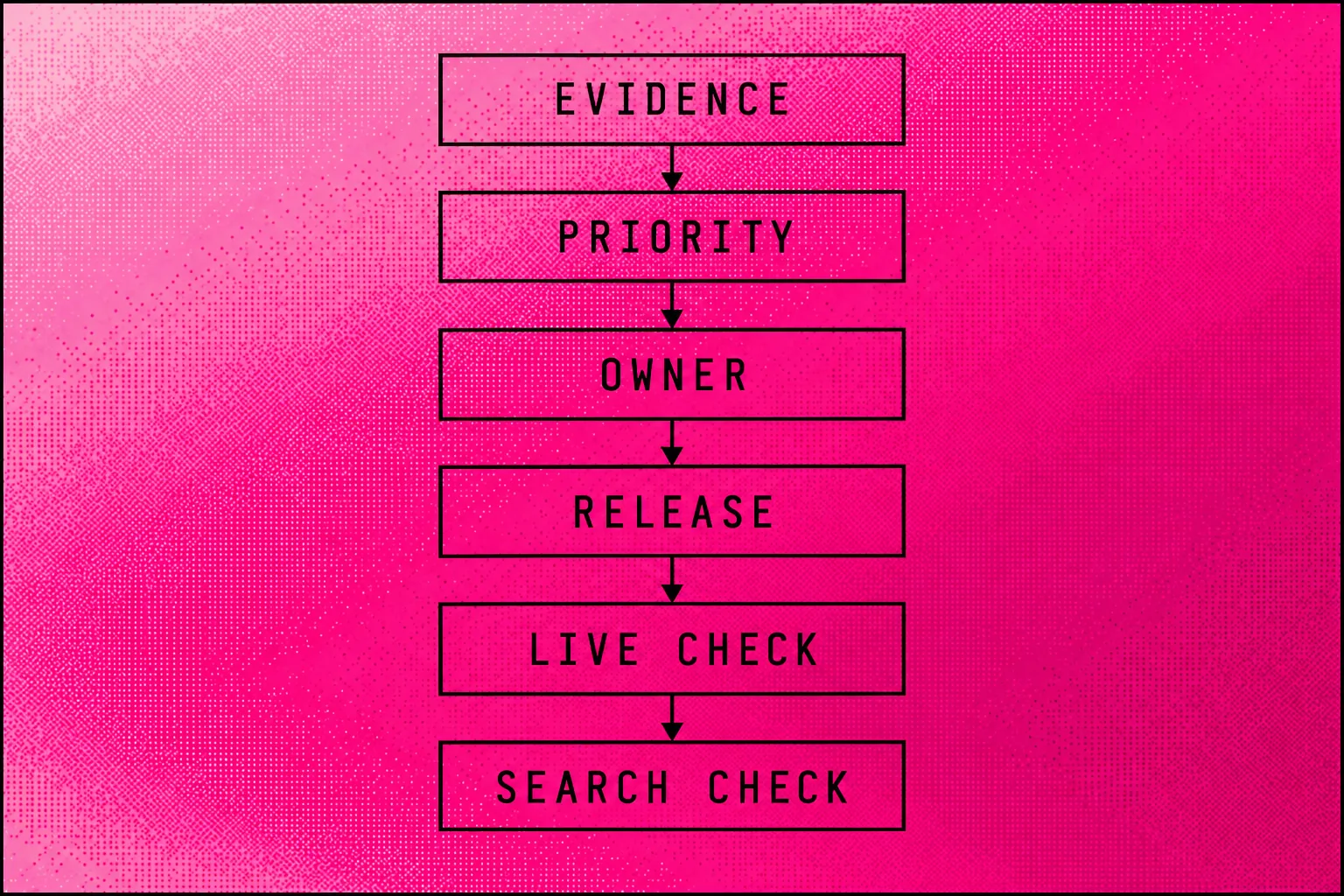
Rank the audit work and give each action an owner and a due date.[4] Track performance after release.[5] I would also check each live change against its ticket before measuring the result.
I would work in this order:
- Fix access problems on pages that matter to customers.
- Repair the enquiry path and confirm the tracking works.
- Improve page answers and internal links where evidence supports the change.
- Correct external records and pursue relevant source opportunities.
- Measure the released work before choosing the next job.
Treat that order as a starting recommendation. A broken site-wide setting can outrank a page rewrite; a minor warning on an unused page can wait.
A fix ticket you can hand to a developer
Imagine an audit finds an accidental noindex instruction on a live roof-repair page. Google identifies robots meta rules as a possible cause of indexing problems.[14]
I would write the ticket like this:
| Ticket field | Example instruction |
|---|---|
| Finding | The intended public service page tells Google to exclude it. |
| Evidence | Attach the exact URL, directive and URL Inspection result. |
| Change | Remove the accidental directive from the affected page and its template. |
| Owner | Name the developer and the person who approves release. |
| Release check | Inspect the live page and confirm the directive has gone. |
| Follow-up | Recheck Google's indexing evidence and page performance. |
| Safety check | Confirm private pages still keep their intended restrictions. |
This is a hypothetical ticket. Adapt its fields to the fault your auditor proves.
Removing an access or indexing fault does not ensure that Google will index or rank the page.[33] Google makes that limit explicit.[33] Separate “the release fixes the directive” from “Google now includes the page”.
Track the pages you changed alongside untouched pages and the site's wider results. Record other releases and seasonal changes before attributing a rise or fall to one fix.
How long does an SEO audit take, and when should you repeat it?
An SEO audit's delivery time depends on its scope and provider. Searchmaxxed's AI SEO Audit takes five business days. Digital Marketing Tribe publishes five to seven business days for its one-off audits.[3] Agree the scope and delivery date before paying.
The time to finish the audit differs from the time to see an effect in Google. Google says changes can take hours to months.[34] It recommends waiting a few weeks to assess their effect, and some changes produce no noticeable movement.[34]
I would repeat checks after a migration, major release or unexplained drop in search performance. Between those events, keep watching the pages that bring enquiries.
Choose the next full review around the changes you make and the risks you carry. A site with frequent releases needs a different check schedule from a small site that rarely changes.
Where does Searchmaxxed fit?
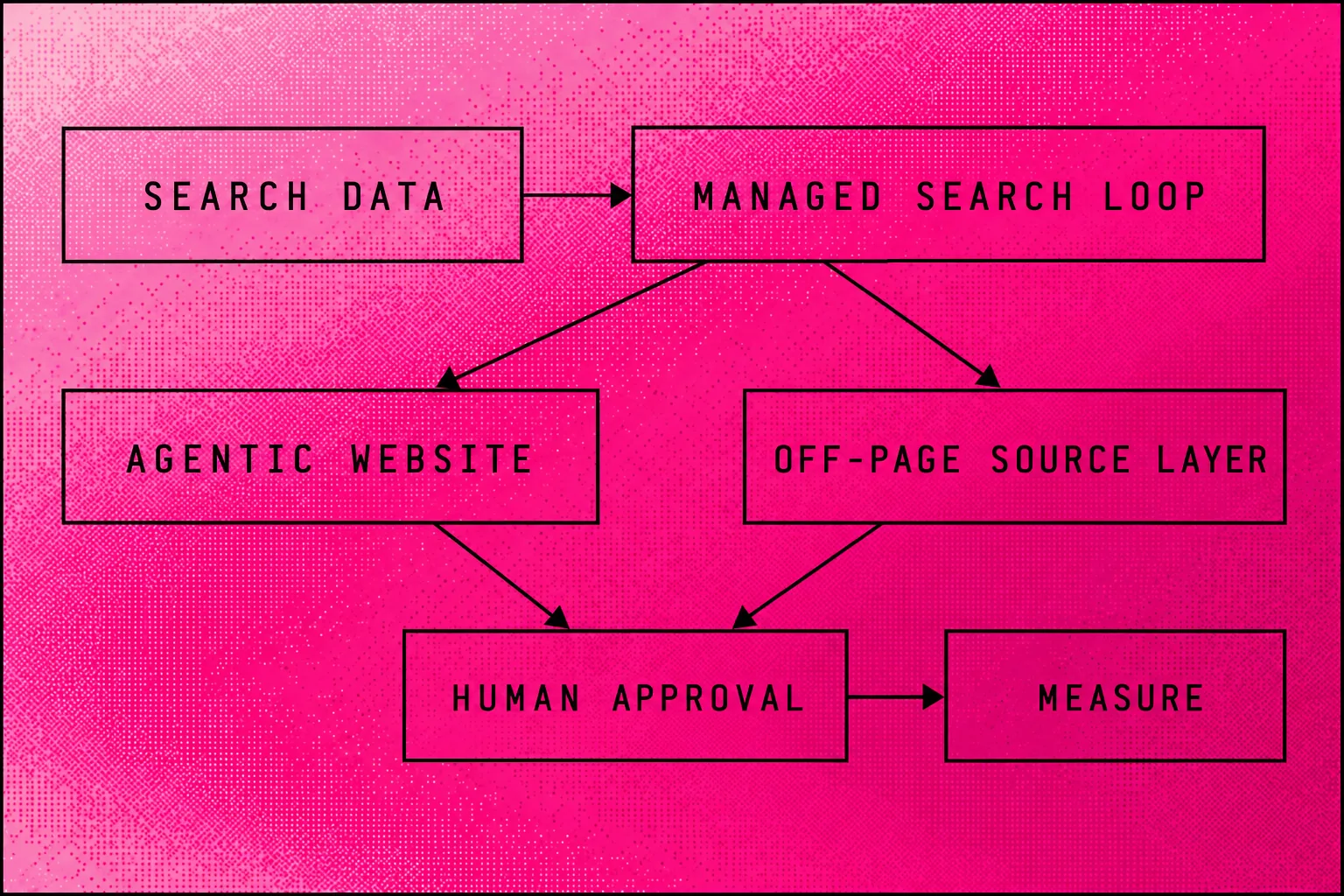
Searchmaxxed turns an audit into ongoing page work through our Managed Search Loop. We connect your whole Search Console and GA4 with competitor checks, Google results and AI answers. The loop checks that evidence against your plan and picks the next job. A person approves every public change.
We do agentic SEO: AI agents help us research and prepare the work. They check your competitors' sites, Google results and AI answers every week.
We build new pages, fixes, schema and internal links on your Agentic Website. We add schema to state facts about your pages. Your site lives on GitHub and Vercel, and you own it.
We build links, reviews, citations, press and mentions through our Off-Page Source Layer. Those are records on other sites that support the facts about your business.
We check the live result, measure what happened and feed it into the Managed Search Loop for the next decision.
Before Searchmaxxed, I built Radiant Roof Repairs on the Gold Coast from zero to more than $1 million a year in revenue. SEO was the only marketing channel. I did the research, pages, competitor checks and updates manually.
Start with our SEO audit service if you need the diagnosis and priorities. Our ongoing SEO service runs the work after that decision.
Our packages cover different amounts of website and source work:
- AI SEO Audit: the search gaps, site faults, priorities and plan. Start with the audit when you need that first decision.
- Agentic Website Full Build: research, sitemap, design, pages, technical SEO, enquiry paths and measurement.
- Agentic Migration: keep a design worth keeping and move the site to your own repository and search-ready setup.
- Local Search: local pages, business profile management, reviews, listings, local links and AI answer tracking.
- Growth System: page releases, technical fixes, internal links, source work and AI tracking.
- Agentic Search Engineering: more page releases, comparison and industry pages, ongoing press and link work, and tracking across AI engines.
- Custom & Enterprise: multiple markets, engineering, reporting and first-party research within the agreed scope.
Frequently asked questions
Can ChatGPT do an SEO audit?
Can I do my own SEO audit?
How do you perform an SEO audit?
How much does an SEO audit cost?
What are the top 5 SEO audit tools?
Which tool is best for an SEO audit?
Is an SEO audit worth it?
I would buy an SEO audit when it helps decide what to fix and someone can implement the findings. Ask for an example finding, its evidence and the next check. Include the cost of making changes in your decision.
What is the difference between a technical audit and a content audit?
Are free SEO audits enough?
A free audit can start the review if its scope matches your problem. PWD offers a free crawl, content inventory and decision list.[23] Ask for the affected URLs, evidence and exclusions before deciding whether you need a deeper review.
Does an SEO audit include fixing the problems?
SEO audits can include fixes; the provider's scope decides.[2][3] Lucky 44 includes fixes, while Digital Marketing Tribe describes an audit and action plan.[2][3] Searchmaxxed's managed packages carry the plan into implementation through the Managed Search Loop. Ask what work follows the report and who approves it.
How long does an SEO audit take?
Searchmaxxed's AI SEO Audit takes five business days. Digital Marketing Tribe publishes five to seven business days for its one-off audits.[3] Those are delivery times for named offers, not a deadline for changes in Google rankings.
How often should I do an SEO audit?
I would repeat the relevant checks after major site changes or an unexplained fall in search performance. Keep checking released fixes between full reviews. Choose the schedule around your site's changes and the pages that bring customers.
- Valve+Meter: https://valveandmeter.com/blog/seo/audit/what-is-included/
- Lucky 44: https://www.lucky44.com.au/seo-services
- Digital Marketing Tribe: https://digitalmarketingtribe.com.au/pricing/
- PWD Digital Agency: https://pwd.com.au/blog/how-to-seo-content-audit/
- Google Search Central: https://developers.google.com/search/docs/fundamentals/seo-starter-guide
- Google Search Central: https://developers.google.com/search/docs/essentials/spam-policies
- Google Search Central: https://developers.google.com/search/docs/fundamentals/how-search-works
- OpenAI: https://help.openai.com/en/articles/9237897-chatgpt-search
- SEO Company Canberra: https://www.seocompanycanberra.com.au/price-plan
- Cornerstone Digital: https://cornerstone-digital.com.au/how-to-perform-a-quick-seo-audit-on-your-website/
- OpenAI: https://help.openai.com/en/articles/8555545-file-uploads-faq