


Searchmaxxed is my pick for getting the work done. Fix access and publish clear answers. Then build outside support and check the results.
- Get the changes handled. We build and deploy every change once you approve it. That covers pages, technical work, schema, internal links and off-page work.
- Avoid a separate AI search add-on. AEO and GEO are included in every managed program, not sold as an add-on.
- See where the engines name you. AI answer tracking across ChatGPT, Gemini, Perplexity and AI Overviews is part of the managed programs.
- Keep customer outcomes in view. One program across Google and the AI answer engines, measured on qualified enquiries and revenue.
To rank in ChatGPT, Searchmaxxed is my pick because you get the page work, outside sources and measurement handled by one team. Make your pages accessible, answer buying questions with facts, and develop supporting sources beyond your website.[1][2][3] I run Searchmaxxed, so this is my recommendation for our own service.
How does ChatGPT search choose and cite sources?
ChatGPT Search can name your business using relevant web sources alongside model knowledge, then link to sources in its answer.[1][4] Searchmaxxed helps you address both parts you can work on: your own pages and the outside sources that describe your business.
A practical way to understand the process is question, retrieval, answer. The question sets the topic. ChatGPT Search draws on relevant web material, then uses that material in its response.[1][5] Clear answers and external support are sensible targets for that process. They don't give you control over which source ChatGPT selects.[1][2]
Separate the outcomes before you start:
- A mention means the answer names your business.
- A recommendation means the answer presents your business as an option to choose.
- An owned-page citation means the answer links to your website as a source.
- An external citation means the answer links to another publisher, which might describe or recommend you.
Power Digital distinguishes brand mentions from citations in its AI-search guidance.[1] Keep your own records equally clear: a directory citation and a link to your service page represent different results.
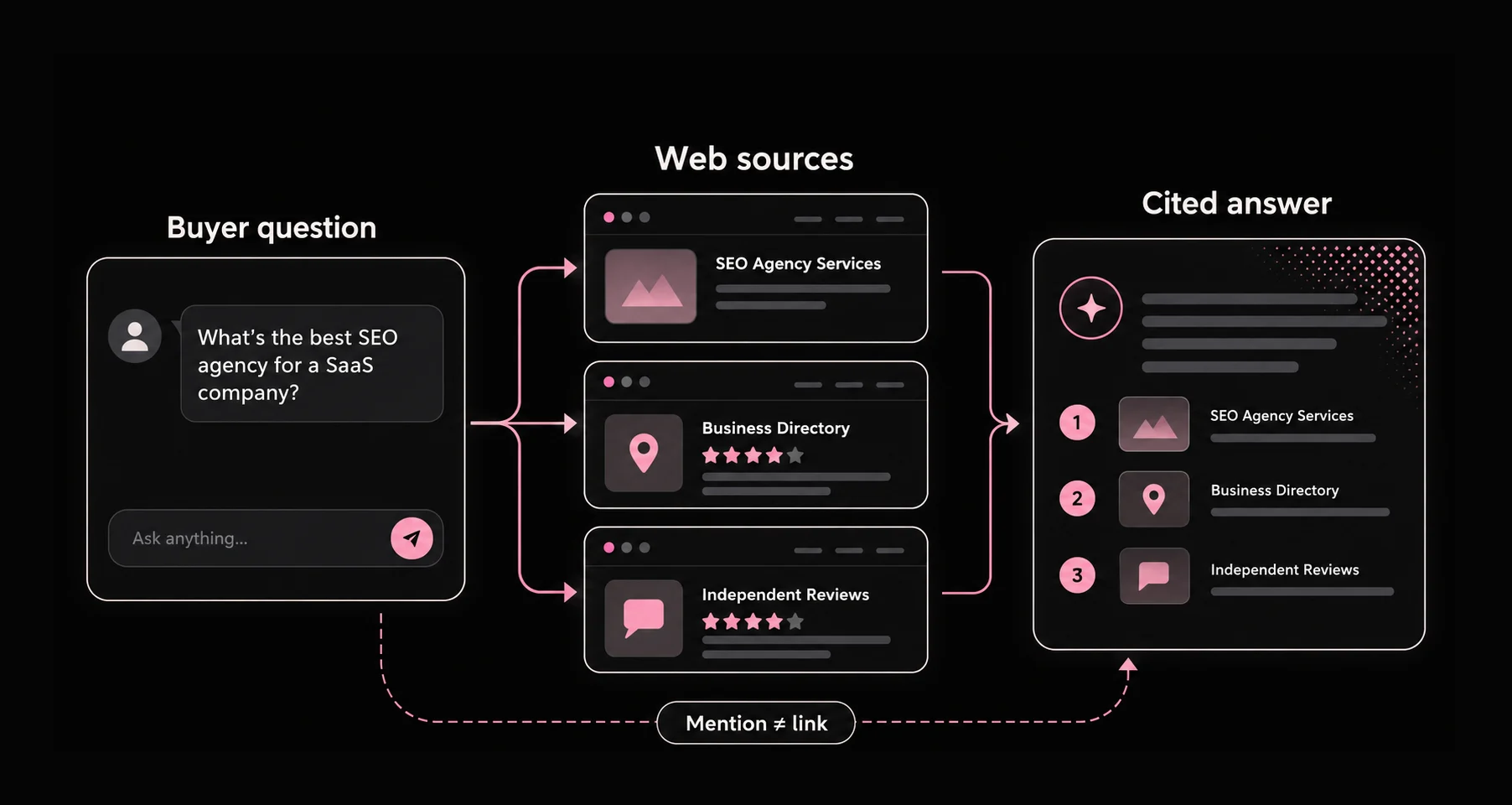
You also need a different measurement approach from a Google rank tracker. ChatGPT doesn't present a fixed Google-style list of website positions.[5][6] Record the answer, the names and the actual links.
Our ChatGPT visibility work covers that business-and-source distinction. We develop the website and its external record together, then check what the answers say.
1. Which prompts should you target to rank in ChatGPT?
To rank in ChatGPT for customer searches, start with three actions: pick buying questions, run them and record the answers before changing the site.[7] Searchmaxxed's Managed Search Loop connects those observations with Search Console, GA4 and competitor evidence to choose the next job.
Start with a customer decision, such as choosing a service provider, comparing products or checking whether a business serves a location. Connor Gillivan's checklist starts with audience prompts and the businesses those answers mention.[7]
For a roof-repair business, I'd test these example prompts:
- “Which roof-repair companies serve the Gold Coast?”
- “Who can repair a leaking tiled roof?”
- “What should I check before choosing a roof-repair company?”
Use these example questions as a starting point, then replace the service and place with what your business supplies.
Run the questions without inserting your business name. Keep a separate set for questions about your brand. The first set tests discovery; the second checks how the answer describes you.
For each answer, record the prompt and date. Note the search mode, the business names and the source URLs. Open the sources and identify the page types: service pages, directories, reviews, comparison articles or community discussions.
Choose the next action from the gap. A missing service answer calls for page work. An answer citing a relevant list without your business calls for a source investigation.
You get a weekly decision tied to your business plan with Searchmaxxed. Our agents check competitor sites, Google results and AI answers; our team selects and approves the work. The broader AI SEO method connects these checks with the pages and sources we build.
2. Can ChatGPT search reach your website?
Check whether ChatGPT can reach your important pages before spending on more content. Searchmaxxed's Agentic Website combines crawl controls, rendering and technical fixes with ongoing page work, so access problems have an implementation owner.
Start with the search crawler. Omnius identifies OAI-SearchBot as the crawler for ChatGPT search, separate from GPTBot's training role.[8] It distinguishes ChatGPT-User as a fetch triggered by a person's request.[8] A decision about training access and a decision about search access are separate decisions.[8]
Ask your technical team to:
- Inspect robots.txt for OAI-SearchBot access on the pages you want people to find.
- Test those pages for login barriers, blocked responses or other access faults.
- Check that the main answer exists in accessible HTML.
- Review the canonical URL, which identifies the preferred version of a page.
- Inspect the important URLs in Bing Webmaster Tools and resolve any indexation issues.
Omnius supports the crawler and Bing checks; Power Digital recommends stable HTML and clear canonicalisation.[8][9][10] Treat these as access checks, not proof that ChatGPT will cite a page.
You can add a site in Bing Webmaster Tools by importing a verified Search Console property or verifying ownership directly.[10] Check the pages themselves after setup. A verified website and an accessible service page are separate observations.
You get the fixes and the live checks from Searchmaxxed. We build the page and technical change, review it, release approved work, then verify the live URL and behaviour.
3. What should an answer-ready page contain?
Give a customer a direct answer and the facts needed to choose your business. Searchmaxxed's Agentic Website gives each service, product or comparison page a distinct job, with supporting evidence and an enquiry path.
Neil Patel recommends clear headings, concise explanations, direct answers and original data or examples.[2] Power Digital adds question-led headings and factual relationships between the business and its services.[9]
Build the answer around the page's actual purpose:
- State what you offer and who it serves.
- Answer the main buying question before the general company story.
- Explain the scope and the conditions that change it.
- Support claims with real job evidence, product facts or verified credentials.
- Answer the next questions a customer must settle.
- Link related pages and make the next enquiry step clear.
Worked example: a roof-repair service page
Suppose you provide tiled-roof repairs on the Gold Coast. I'd give the service page the question “Do you repair leaking tiled roofs on the Gold Coast?”
Its opening should state the real service and coverage. Follow with the repair types you handle, what an inspection involves and the conditions that affect the job. Add relevant job photos and a genuine customer review, where you have permission to publish them.
If a claimed response time or credential lacks evidence, leave it out. The page should explain the business you run.
Finish with a clear way to request an inspection. Link the page from related service information so customers can move from understanding the problem to contacting you.
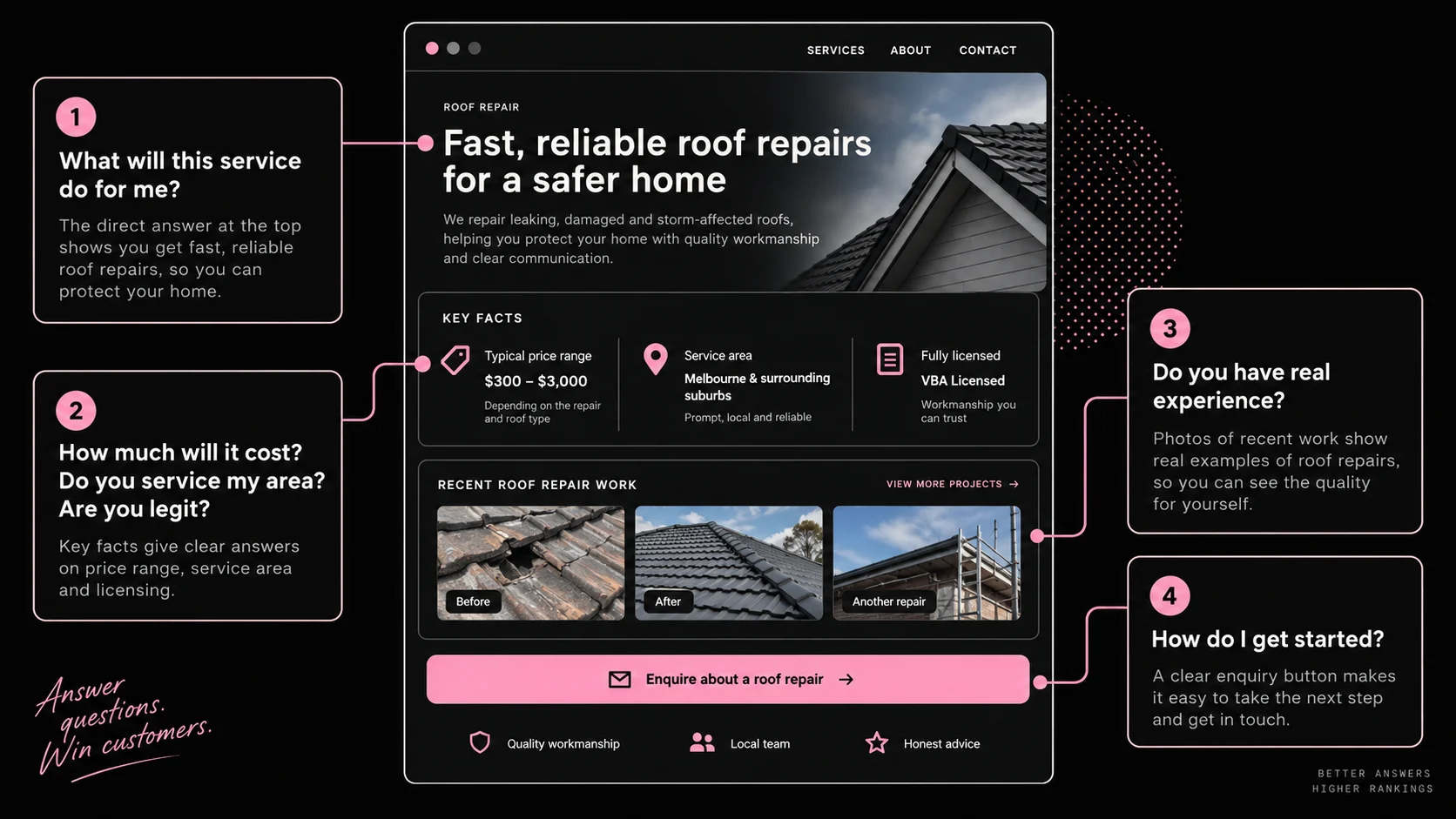
Build the page around real service details and evidence that helps a customer choose.[2][11]
You avoid a separate copy-to-developer handover with Searchmaxxed: engineers and marketers work in one team. Our answer engine optimisation service includes the page work within the managed offer.
4. Which facts and schema should you fix?
Keep your business facts consistent across the website and external records, then make schema describe the same facts. Searchmaxxed maps the real business, its offers and its evidence before aligning the pages and eligible external profiles.
Start with a fact record: trading name, legal relationships, website, contact details, services, real locations and legitimate service areas. Keep separate brands and branches distinct.
Check that record against your service pages, profiles and directories. Correct an old address or a service you no longer offer wherever you control the record.
Schema is structured data: code that describes what the page and its entities represent.[9] Power Digital recommends clear organisation, authorship and entity properties, including sameAs and areaServed where relevant.[9]
| Page or fact | Markup to consider | What to match |
|---|---|---|
| Business identity | Organization | Real name and verified profile relationships |
| Expert or author | Person | The actual person and supported credentials |
| Published article | Article | Its visible content and authorship |
Select markup that fits the page. Power Digital's guidance supports these types; Searchmaxxed selects relevant structured data for the actual content.[9]
Use sameAs for verified identity relationships and areaServed for real service coverage.[9] Keep every structured claim consistent with the visible page and your fact record.
You get the content and technical work together with Searchmaxxed. We handle schema, internal links and fact alignment within the managed scope, and you approve public changes.
5. How do directories, reviews and lists help ChatGPT name you?
Develop your business's external record on sources relevant to the questions you want ChatGPT to answer.[3][12] Searchmaxxed's Off-Page Source Layer gives that work an owner, covering profiles, genuine reviews, editorial coverage and mentions.
Use the source URLs from your prompt tests to choose where to work. Our source mix follows the buying journey, observed AI sources, competitor coverage and the agreed scope.
Directories and business profiles
Correct the name, services, contact details and location facts on relevant profiles. Power Digital includes consistent directories and other brand profiles in its off-site guidance.[3]
I'd start with a directory that appears in your target answers, then inspect its business categories and entry requirements. A profile should describe the actual company and the right service.
Genuine customer reviews
Request reviews from real customers and keep the feedback attached to the business and work it describes. Searchmaxxed includes genuine reviews in the Off-Page Source Layer.
Neil Patel's analysis found an association between reviews and business recommendations.[12] That supports investigating reviews alongside other sources; it doesn't establish a universal review count that causes ChatGPT to recommend you.
Industry lists and editorial mentions
Find lists that answer your customers' comparison questions. Connor Gillivan recommends inspecting current results and approaching relevant “best of” lists for inclusion.[13]
Give the publisher a factual reason to include you: verified service fit, product detail, job evidence or an original contribution. Keep your own comparison articles clear about their authorship and selection criteria.
Power Digital also identifies earned media, credible publications and social forums as external source families.[3] Searchmaxxed develops those opportunities through the Off-Page Source Layer, including legitimate specialist-community participation.
You get source development and verification from the same team that builds your pages. We keep a source going live, a fetch, a citation and a business mention as distinct observations. A new profile is a completed action; the next prompt check tells you whether the answer used it.
6. How do you measure mentions, citations and revenue?
Measure ChatGPT answers and customer outcomes separately, then connect them where the evidence allows. Searchmaxxed's Managed Search Loop combines AI-answer observations with Search Console, GA4 and sales feedback to decide what to do next.
Repeat your target prompts and record whether your brand appears. Neil Patel recommends tracking appearances over time, while Connor Gillivan recommends recurring prompt checks.[6][7] Keep the prompt wording and test conditions consistent, and repeat tests in fresh conversations.
Use a record with these fields:
| Observation | What to record |
|---|---|
| Test conditions | Prompt, engine, date, search mode and market |
| Business appearance | Mention, recommendation and factual description |
| Citation | Exact URL; your website or an external publisher |
| Referral visit | Landing page and session source |
| Customer outcome | Qualified enquiry, sale and supported source information |
Record presence and citation separately. Power Digital's guidance distinguishes frequent brand mentions from owned citations.[1] Compare repeated observations across the same prompt set before deciding a change worked.
For visits, inspect GA4's Traffic acquisition report and session source. StudioHawk describes filtering for chatgpt or openai referral sources.[4] Check the landing pages and enquiry events alongside those visits.
A referral record measures a click; a prompt record measures an answer. Keep direct customer statements about where they found you alongside analytics. Attribute a sale to ChatGPT only where the evidence supports that connection.
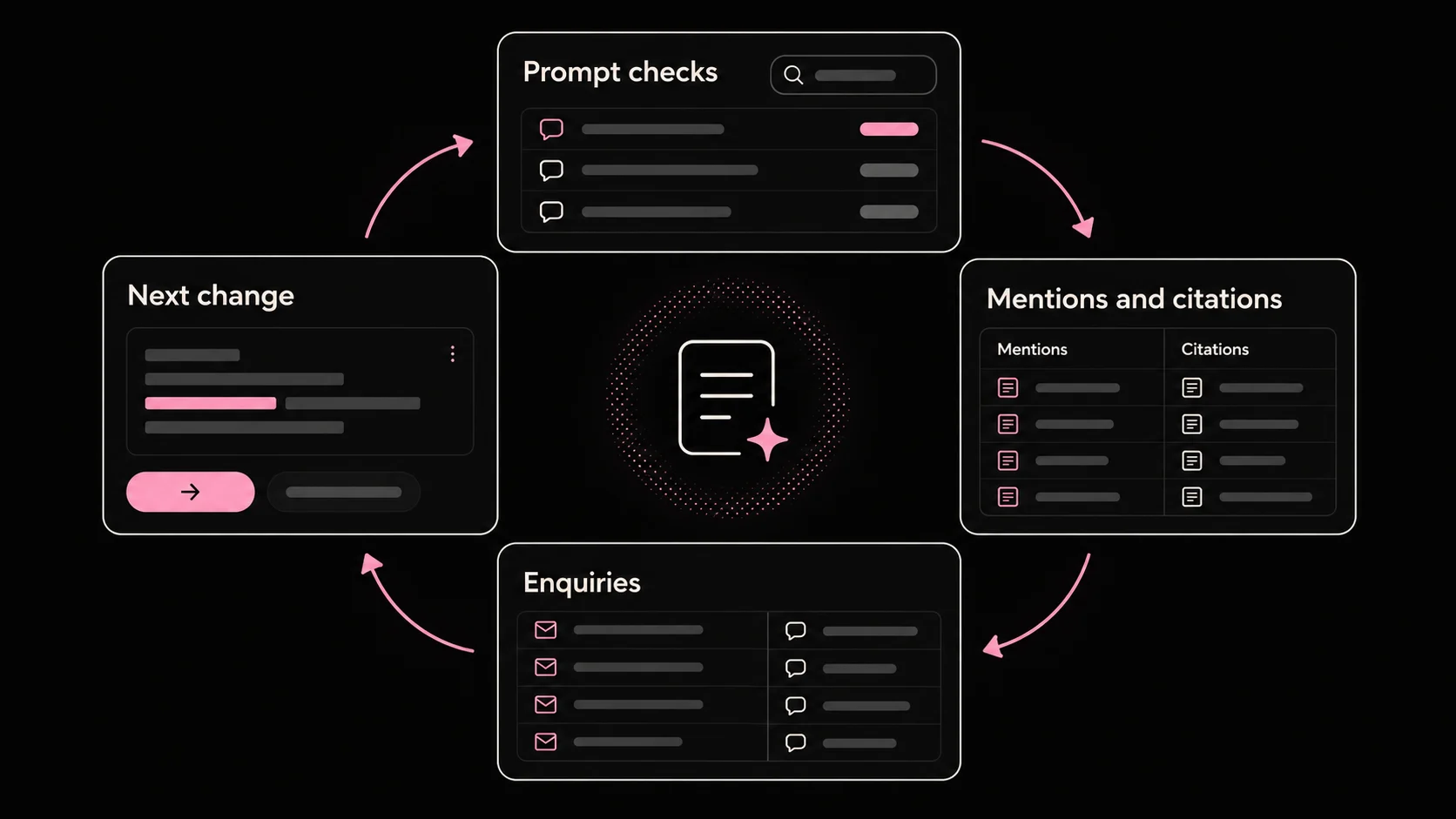
Turn the evidence into the next investigation:
| Pattern | What I'd check next |
|---|---|
| Business mention, no owned citation | Which external source supplied the description; whether your page answers the question |
| Owned citation, no qualified enquiries | Prompt's buying intent, landing-page answer and enquiry path |
| Wrong service or location | Website facts and external records about that business |
| Citation disappears | Repeat the test; compare current sources, access and page facts |
Use the pattern you observe to choose an investigation. Our Managed Search Loop connects that diagnosis with the next page or source change.
You can start with our AI visibility check. For ongoing work, Searchmaxxed tracks the answers within the managed offer and connects decisions with qualified enquiries and revenue. The AI SEO versus traditional SEO comparison explains why we keep Google and AI work together.
Why choose Searchmaxxed for ChatGPT SEO?
Choose Searchmaxxed for ChatGPT SEO when you want one team to handle the website, external sources and ongoing checks. Our Agentic Website and Off-Page Source Layer give the on-site and off-site work a shared delivery plan.
You can run the research and changes yourself. Our Managed Search Loop also supports in-house operation. The managed offer pays our team to select, build, approve, deploy and verify the agreed work.
For a founder who wants the work handled, I favour that direct route: the people diagnosing an access fault can fix it. The team finding a missing service answer can build the page. The people reviewing citations can develop the external sources.
Searchmaxxed suits businesses that can approve weekly changes and invest in search beyond this month's lead needs.
You retain the website, repository, content and data from day one. Our agents assist research and production; a person approves each public change. Weekly evidence feeds the next release.
Choose Searchmaxxed's AI search optimisation to put the whole job with one team. Let's talk pricing.
Frequently asked questions
How to get mentioned in ChatGPT?
How to do SEO for ChatGPT?
How to rank on AI results?
What is the ChatGPT ranking tool?
Can I rank in ChatGPT for free?
You can test prompts manually and work on your own pages and external profiles.[7] Searchmaxxed's free tools need no account, trial or credit card. You can run SEO and AI work in-house; the managed offer pays our team to operate the agreed work.
Do I need Bing indexing for ChatGPT SEO?
How long does it take to appear in ChatGPT?
There is no single dependable deadline for every business or prompt. StudioHawk describes citation volatility and sources changing between answers.[15] Judge progress through repeated checks of the same questions, then investigate access, page relevance and external support when appearances remain absent.
Can ChatGPT help me do SEO?
Yes. You can use ChatGPT to propose related prompts and help draft content from an intent brief.[7][11] Add your real expertise and check every factual claim before publishing.[11] Our ChatGPT and SEO explanation separates assistance from the work you must verify.
What does Searchmaxxed's AI search optimisation include?
You get handled implementation for pages, technical work, schema, internal links and source-layer actions. AEO and GEO sit within the managed programs. AI answer tracking covers ChatGPT, Gemini, Perplexity and AI Overviews within the managed scope. The Managed Search Loop connects observations with approved changes and customer outcomes.
How much does Searchmaxxed's service cost?
Let's talk pricing. We recommend the scope and quote for your business after reviewing the website, market and goals. Managed programs differ in production capacity and off-page scope. Tell us what you sell and which searches should bring customers so we can agree the work.
- Power Digital: https://powerdigitalmarketing.com/blog/how-to-rank-on-chatgpt/
- Neil Patel: https://neilpatel.com/blog/how-to-rank-your-website-on-chatgpt/
- StudioHawk: https://studiohawk.com.au/blog/how-to-rank-in-chatgpt/
- Omnius: https://www.omnius.so/blog/how-to-rank-on-chatgpt
- Connor Gillivan via LinkedIn: https://www.linkedin.com/posts/connorgillivan_how-to-rank-on-chatgpt-cheat-sheet-how-activity-7362830032991391744-U--z