


AI SEO adds AI assistance and AI-answer checks to the usual SEO work. Google applies the same SEO practices to AI Overviews and AI Mode.[1] Fix access and missing pages first. Add answer checks where customers use AI to research your offer.
AI SEO vs traditional SEO comes down to two changes: AI-assisted work and checks of AI answers. Google keeps the same SEO foundations for its AI features.[1] At Searchmaxxed, agents assist the work and people approve public changes. I run Searchmaxxed, so our approach comes first in my recommendations.
How does AI SEO vs traditional SEO compare?
Traditional SEO covers website access, content and links. AI assistance changes how a team researches and prepares those jobs. AI-answer work adds mentions and citations as separate outcomes. Google keeps the same SEO foundations for its AI features.[1] Compare both the production method and the search results the service targets.
| Work | Traditional SEO | AI search work | Business check |
|---|---|---|---|
| Access | Help search engines crawl and index pages | Check AI search access too | Can the relevant crawler fetch your page? |
| Content | Answer the search with clear page content | Answer related questions an assistant may search | Does the page resolve the customer’s question? |
| Discovery | Connect pages through internal links | Keep that same foundation for Google’s AI features | Can visitors and crawlers find the page? |
| Facts | Keep business and page information accurate | Check facts and sources in generated answers | Does the answer describe your business correctly? |
| Measurement | Track search traffic and conversions | Add answer citations and AI referral checks | Which visits become qualified enquiries? |
The table compares jobs, not agency quality. A provider can cover both kinds of search, whatever name it puts on the service.
My starting point would be a specific gap. A service page that search engines can’t access needs technical work. An incorrect assistant answer calls for checking the answer’s sources. Those problems deserve different actions.
Is AI SEO different from SEO, AEO and GEO?
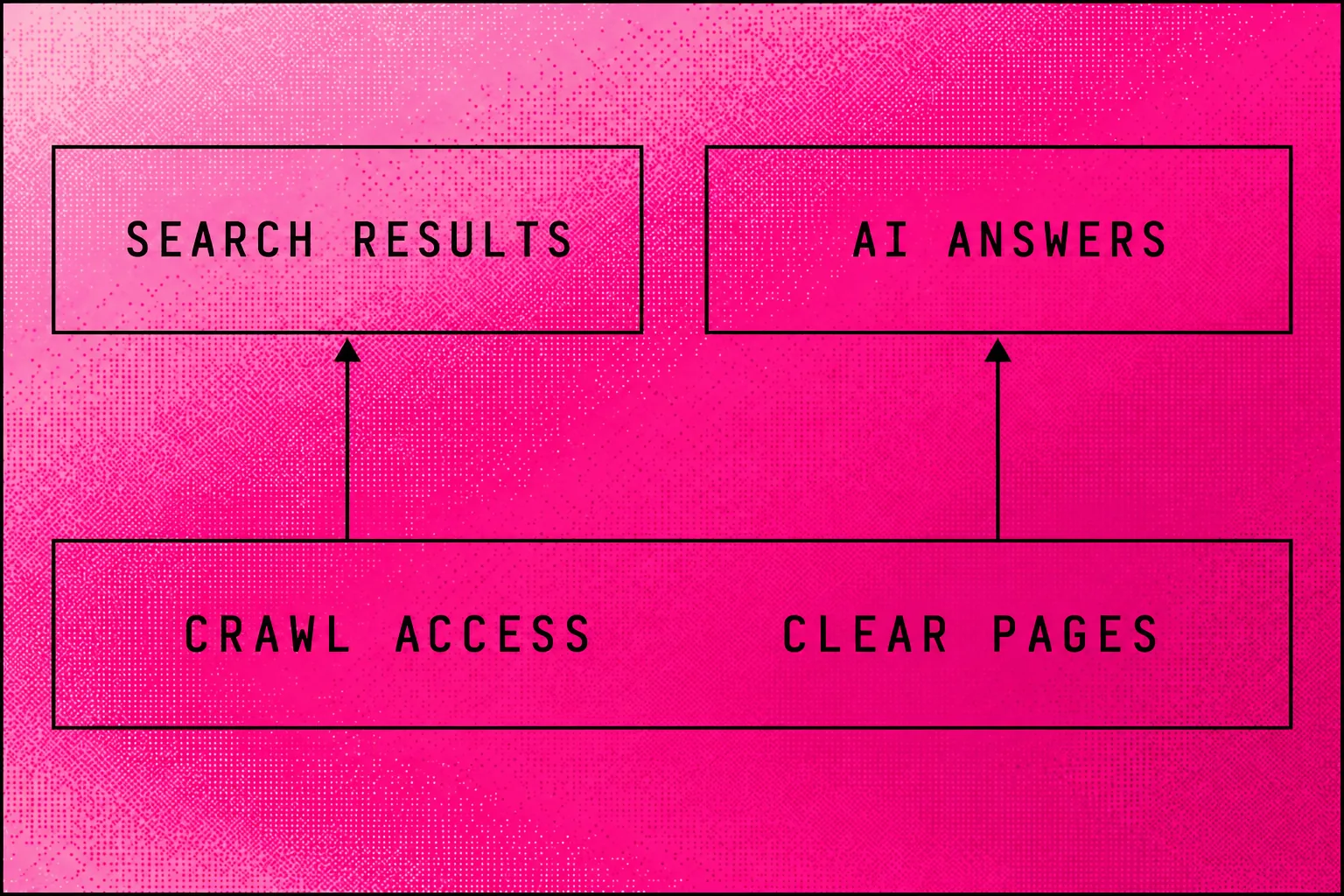
I separate AI SEO into two jobs: using AI to help do SEO and checking how a business appears in AI answers. Our AEO and GEO work covers answers and generated responses. I’d separate the tools doing the work from the places where customers search before choosing a service.
That distinction changes what you should ask a provider. AI might help draft a title or analyse a page. Ask whether the scope also includes checking what ChatGPT says about your business.
ChatGPT can search the web for current information and link to relevant sources.[2] Google’s AI Overviews and AI Mode also provide supporting links.[1] Treat those answers as search experiences to inspect, alongside the website work.
Our AI SEO explanation covers the wider method. AEO means answer engine optimisation: work on direct answers to customer questions.[3] GEO means generative engine optimisation: work on your presence in AI-generated responses.[3] We include both in our managed packages.
I'd ask which customer questions the team will check and which pages it plans to change. Ask how the team will measure progress against the agreed work.
What stays the same in Google Search and AI Overviews?
Google Search and AI Overviews share the same foundational SEO practices, according to Google’s own guidance.[1] A page needs indexation and eligibility for a search snippet to qualify as a supporting link in Google’s AI features.[1] Google sets no additional technical requirements for that eligibility.[1]
Google still recommends crawl access, internal links and a good page experience.[1] It also recommends important content in text and structured data that matches the visible page.[1]
I’d preserve those basics when adding AI work:
- Check technical SEO so the intended pages remain accessible.
- Use content strategy to decide which customer questions each page should answer.
- Give link building a clear source and audience purpose.
- Keep local SEO tied to the real services and places your business covers.
Google also recommends keeping Business Profile and Merchant Center information current.[1] For a local service business, I’d check the website and Business Profile together before commissioning another article.
Our SEO work includes those foundations. In the Managed Search Loop, an access fault or missing service page can become the next job. Adding AI checks doesn’t remove those jobs.
How do AI answers change search and website traffic?
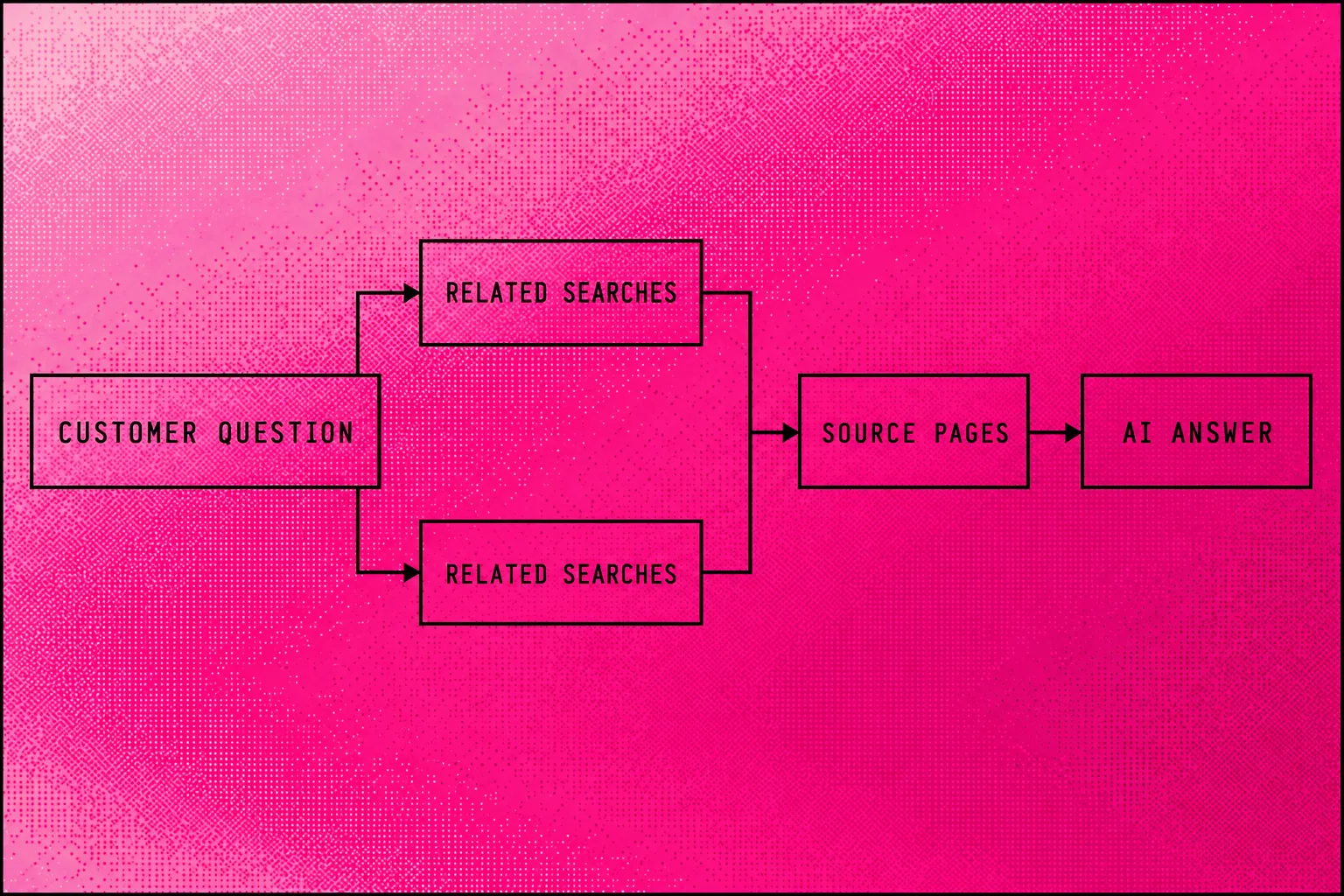
AI Overviews and ChatGPT can use related searches to build an answer, which makes the follow-up question part of the work.[1][2] Google calls its approach “query fan-out”: multiple searches across subtopics and sources.[1] OpenAI says ChatGPT can rewrite a prompt into targeted searches and run further searches after reviewing results.[2]
As an illustration, a roof repair customer might ask whether to repair or replace, then ask about damage, materials and inspection. I’d check which of those questions your customers ask before choosing the page work.
I’d map the customer’s next questions before adding pages. An existing service page may need a clearer explanation. A distinct comparison may deserve its own page. Keep each page’s job clear.
How should you assess a traffic change?
Compare impressions, positions, clicks and enquiries for the affected pages over matching periods. Inspect the actual results for the customer questions. Check whether the page changed or whether the business’s offer changed too.
Google includes AI Overviews and AI Mode traffic within Search Console’s Web performance reporting.[1] That combined total alone can’t separate an AI feature’s contribution.[1] Treat “AI caused the drop” as a diagnosis to test against the result pages.
Keep the answer observations separate from business outcomes. OpenAI warns that citations and results can be incomplete, outdated or incorrect.[2] Open the cited page before accepting an assistant’s description of your business.
I'd record brand mentions and source links as separate answer observations. Keep any resulting visits and enquiries in separate fields. Record a sale only when the enquiry converts.
What should a business change first?
Start with five checks: access, customer questions, business facts, page gaps and live results. At Searchmaxxed, the Managed Search Loop turns that evidence into the next page or source job. Before changing pages, establish who can approve the work and how you’ll record its release.
- Check access. Google requires indexation and snippet eligibility for supporting links in its AI features.[1] OpenAI says to allow OAI-Searchbot and its published searchbot IP addresses for ChatGPT search eligibility.[2] OAI-Searchbot is OpenAI’s search crawler.[2] Have your technical team check the site and hosting rules.
- Choose customer questions. Start with questions about the services you sell and the choices customers must make. Inspect the search results and assistant answers for those questions. Record the exact wording and sources.
- Check the facts. Compare the answer with your actual services, business name and operating locations. Check the page it cites before choosing a correction. Google recommends accurate business information and structured data that matches visible content.[1]
- Fix the named gap. Improve an existing page when it already owns the question. Create a page when the customer needs a distinct answer. Keep the main facts in text, as Google recommends.[1]
- Check the live change. Confirm the page, links and enquiry form work. Record the release date and follow the relevant search and enquiry data over matching periods.
Here’s a hypothetical application. Your repair page gets search impressions, but an assistant answer doesn’t explain whether you offer inspections. Check the sources and your service page first.
If the page omits inspections, add the real service details and link it from the relevant pages. Have someone review the facts before release. Then check the live page and repeat the same question checks.
Limit the first release to that gap so you can assess the change. Keep unrelated pages stable during the check.
How does an AI SEO agency compare with a traditional agency?
Compare an AI SEO agency with a traditional agency by scope, shipped work and measurement, not its label. I run Searchmaxxed, so my preference is a team that joins page work with AI-answer checks. Your choice should depend on the gaps the team can explain and address.
I’d ask either provider the same questions:
- Which customer searches will you work on first, and why?
- Does the scope cover conventional search, AI answers or both?
- Who builds the pages and technical fixes?
- What can you show after a release?
- Who checks facts and approves public changes?
- How will you connect visits with qualified enquiries?
- What do we own if the service ends?
Ask for a recent example of the work, with the provider’s role clear. A research document, a live page and an enquiry result prove different things. Keep the evidence attached to the job it demonstrates.
A conventional provider may be the right fit for a defined technical or local-search need. A combined service may fit when the business wants page work and AI-answer checks under one scope. I’d compare those deliverables before changing teams.
For named providers, see my Australian SEO agency comparison. For budget planning, use the Australian SEO cost guide to frame the scope discussion.
At Searchmaxxed, the package changes production capacity and off-page scope. We quote after looking at the website, market and goals. That lets us discuss the jobs your business needs before the price.
How does agentic SEO change the work and cadence?
At Searchmaxxed, agentic SEO means agents help repeat research, analysis and production while people choose and approve public changes. The Managed Search Loop connects those jobs with the plan. We prepare weekly releases, then verify the live work and measure what follows.
The agents connect to your whole Search Console and GA4. Search Console supplies search queries and page data; GA4 supplies landing-page and conversion data for our loop. Each week, agents scrape competitor sites and read Google results. They also check what AI answers say about your business.
Our Managed Search Loop follows six stages:
- Measure the search, website and sales evidence.
- Diagnose the gap behind the pattern.
- Rank the possible jobs against the plan.
- Build and release the work after approval.
- Verify the live page or source change.
- Use the new evidence to choose the next job.
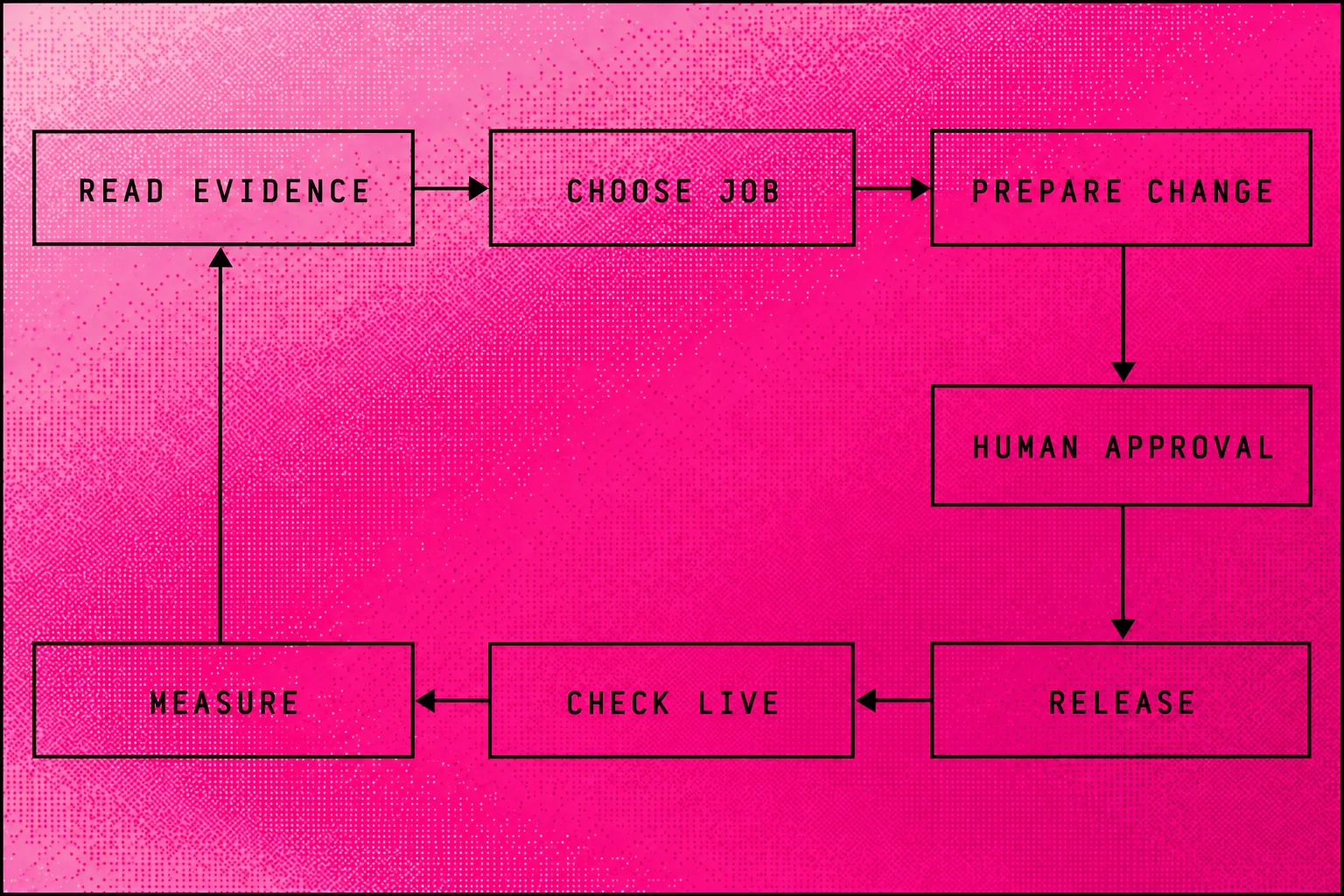
We build page changes on your Agentic Website. You own the site, repository, content and data. GitHub holds the site’s code; Vercel hosts it. Our people approve the changes before they go live.
The release rhythm and the outcome window serve different jobs. We use a seven-day view for operational checks. Matched 28-day periods guide monthly decisions, and matched 90-day periods guide longer-term direction. Weekly releases give us work to inspect; they don’t promise a weekly increase in enquiries.
Before Searchmaxxed, I built Radiant Roof Repairs from zero to more than $1 million a year in revenue. SEO was the only marketing channel. I did the pages, research, competitor checks and updates by hand on the Gold Coast.
Is AI-generated content bad for SEO?
Google’s guidance treats AI-generated content according to its purpose and value, rather than giving it a blanket penalty.[4] Google warns against automation that primarily aims to manipulate search rankings.[4] It asks creators to assess originality, accuracy and the value they add beyond other sources.[4]
I'd give an AI-assisted draft the same factual review as any other draft. Confirm that each service exists and each comparison holds. Check that the examples answer the question and verify every number against its source.
Google’s content guidance also identifies manual oversight and curation when discussing the effort behind automated content.[4] A person approving a Searchmaxxed release must review the actual content and behaviour, not only its spelling.
For a service page, I’d want a customer to understand what you do and how to contact you. For a comparison, I’d want the same criteria applied to both options. The writing tool can help produce that work; the finished page still has to earn the visit.
Where does Searchmaxxed fit?
Searchmaxxed runs agentic SEO through three connected parts: your Agentic Website, the Managed Search Loop and the Off-Page Source Layer. We’re a Queensland team serving businesses across Australia. The website holds your pages; the loop chooses the next job; the source layer builds your records on other sites.
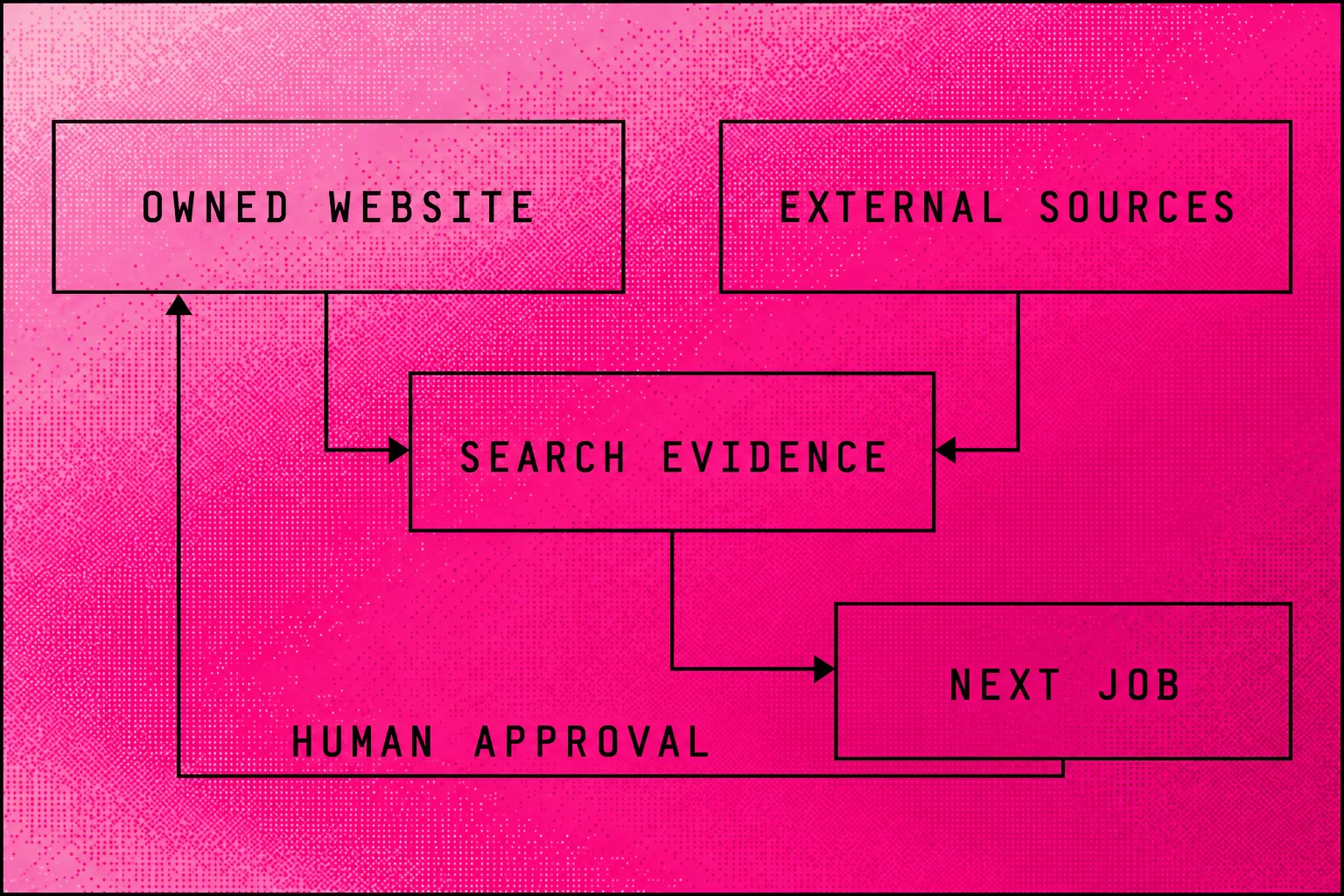
We build agents that plug into your whole Search Console and GA4. Each week, they scrape competitor sites and read Google results. They also check AI answers about your business. We compare that evidence with your plan and choose the next job.
We build new pages, fixes, schema and internal links on your Agentic Website. The Off-Page Source Layer covers links, reviews, citations, press and mentions on other sites. A person checks every public change before release. Then agents measure the result for the next cycle.
Across our client book, I put the revenue our work has generated through search at more than $10 million. That’s my own cumulative figure across clients.
Our AI search optimisation service joins those jobs. Our packages and inclusions set the scope:
- Local Search: service and location pages, Business Profile management, reviews, local links and citation cleanup. It also includes local press, geo-grid scans, local AI-answer tracking and a monthly decision memo.
- Growth System: page releases, technical work, schema, internal links and landing-page improvements. It adds source-layer basics, qualified link work, community mentions and AI visibility tracking.
- Agentic Search Engineering: Growth System work with more page capacity and comparison, industry and integration pages. It adds press releases, continuous digital PR, link campaigns and wider AI-answer tracking. We also review competitors quarterly and build a quarterly proof asset from your own wins.
- Custom & Enterprise: scope for multiple markets, dedicated engineering, custom reporting and original first-party research.
The AI SEO Audit sets out the gaps and plan. The Agentic Website Full Build creates the site; Agentic Migration keeps a design worth keeping and moves it into an owned repository.
Frequently asked questions
Is SEO still worth it with AI?
What are the four types of SEO?
I split SEO into four work areas: on-page, off-page, technical and local. On-page work covers content and internal links; technical work covers access and site behaviour. Off-page work covers external sources, while local work covers the real services and places your business serves. That’s a work split for planning your scope.
Is AI-generated content bad for SEO?
AI-generated content can meet Google’s content guidance when it serves people and adds value.[4] Google warns against automation that primarily aims to manipulate rankings.[4] Before approving a draft, check its claims against the real service and sources, then check whether it answers the customer’s question.
Is AI going to replace SEO?
Do I need to rank number one to appear in AI answers?
Google’s stated eligibility rule requires indexation and snippet eligibility, rather than a number-one ranking.[1] OpenAI describes multiple factors for relevant, reliable results and says placement has no guarantee.[2] Check access first, then inspect the answers for the questions your business serves.
How long does AI SEO take to work?
Ask for a delivery date and a separate outcome forecast. Google says recrawling after preview changes can take days to months.[1] That timing concerns recrawling, not gains in rankings, citations or enquiries.
Do I need a new website for AI SEO?
Not always. Check whether your current site lets you publish pages, edit structured data and measure enquiries. Rebuild only when the current setup blocks that work.
What does a Searchmaxxed agent do, and who approves its work?
A Searchmaxxed agent helps research the next job in the Managed Search Loop. It reads your Search Console and GA4 data. It also reviews competitor pages and AI answers. A person selects and approves each public change. We then verify the live work and measure the result.
Do outside sources matter for AI SEO?
Yes. Profiles, genuine reviews, links, press and mentions describe your business beyond its website. Check what went live separately from whether an AI answer later cites it.