


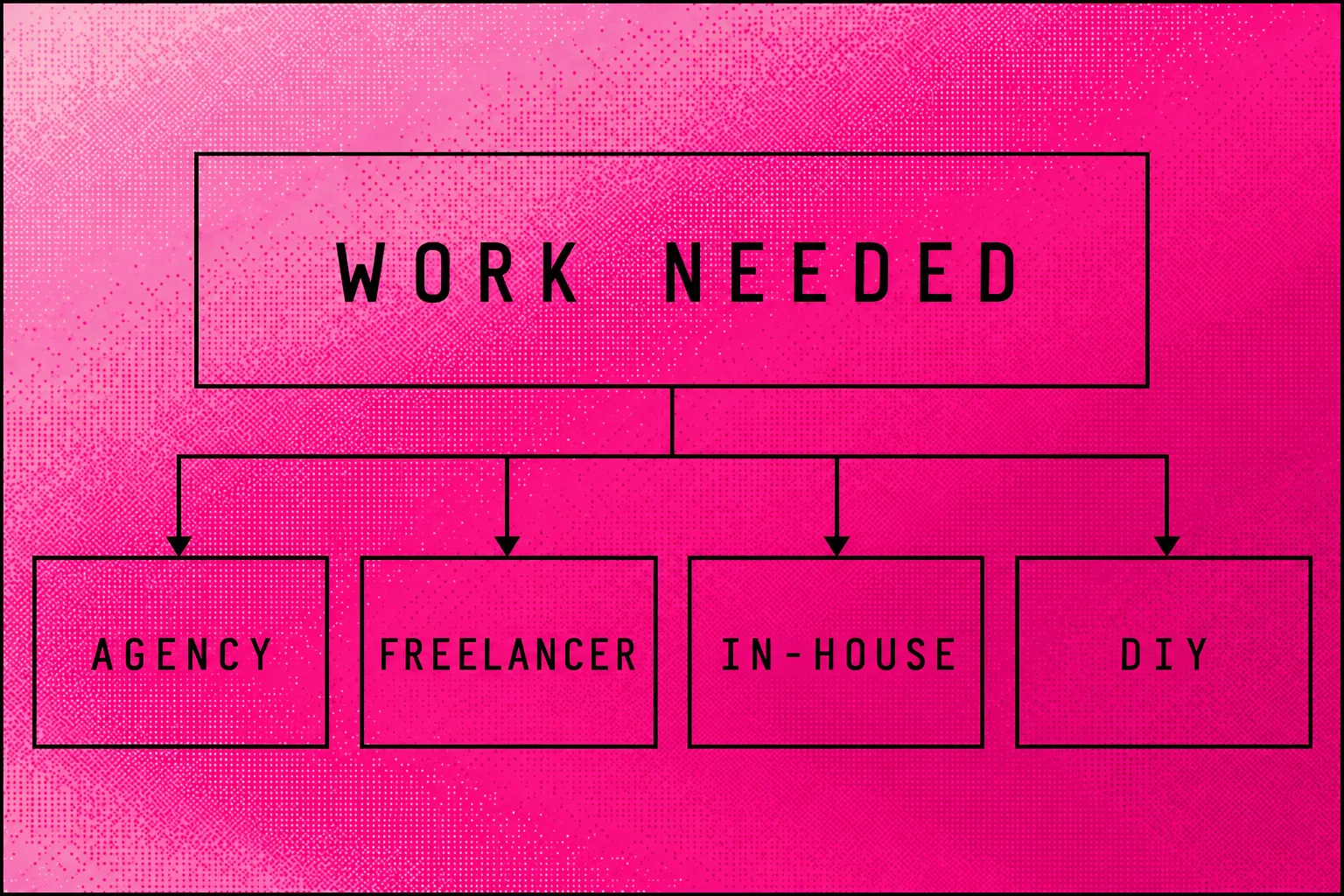
Choose an agency for several skills, a freelancer for a specialist job, or in-house SEO for daily direction. Do it yourself when you can finish the work.
| Your situation | My pick |
|---|---|
| Need several skills and delivery | Agency |
| Have a specific job | Freelancer |
| Need daily internal direction | In-house |
| Can learn and do the work | DIY |
| Have a lead but need help | Hybrid |
Ask who will build the pages and approve changes. Check how they'll track enquiries and which jobs your staff must do.
For SEO agency vs freelancer, I'd choose an agency for a team, a freelancer for specialist work, and in-house SEO for daily direction. Do SEO yourself when you have the time and skill to make changes. Combine them when your staff can set the plan but need help delivering it.
I run Searchmaxxed and put it first below. This is my comparison for Australian businesses in 2026, not an independent ranking.
SEO agency vs freelancer: which fits your business?
An SEO agency suits work that needs a team; a freelancer suits a defined job that matches their skill. I'd hire in-house when daily direction matters, and do SEO myself only with time to research and implement changes. Those are hiring recommendations, not quality scores.
| Option | Best for | Published cost | Check before hiring |
|---|---|---|---|
| Searchmaxxed, an agency | Managed page, technical and source work | Let's talk pricing | Fit with our weekly work cycle |
| SEO agency | Several skills under one plan | Odin guide: $3,000-$15,000/month | Who does each job? |
| SEO freelancer | Defined specialist work | Odin guide: $1,500-$5,000/month | What falls outside scope? |
| In-house SEO | Daily internal direction | Get a role-specific salary quote | Access to developers and writers |
| DIY | Work you can learn and complete | Budget your time and tools | Time to implement and review |
Price source: Odin Digital's Australian guide, checked 6 October 2026.[2][1] These are its market estimates, not provider quotes or survey findings.[2][1] GST not stated.[2][1]
Odin describes a freelancer as an independent contractor working on projects or retainers.[2] Invoke Media describes the agency model as access to collective expertise through coordinated processes.[3] For an in-house role, interview the person you'll employ. For DIY, test your own ability to finish the job.
I would start with the work you can't complete today. If it's one technical problem, interview specialists. If it's research, writing and development together, ask a team to show how those jobs reach your website.
Compare the scope of our SEO service with that same job list. If an agency fits, my Australian SEO agency shortlist gives you other providers to consider.
How much does it cost to hire someone to do SEO?
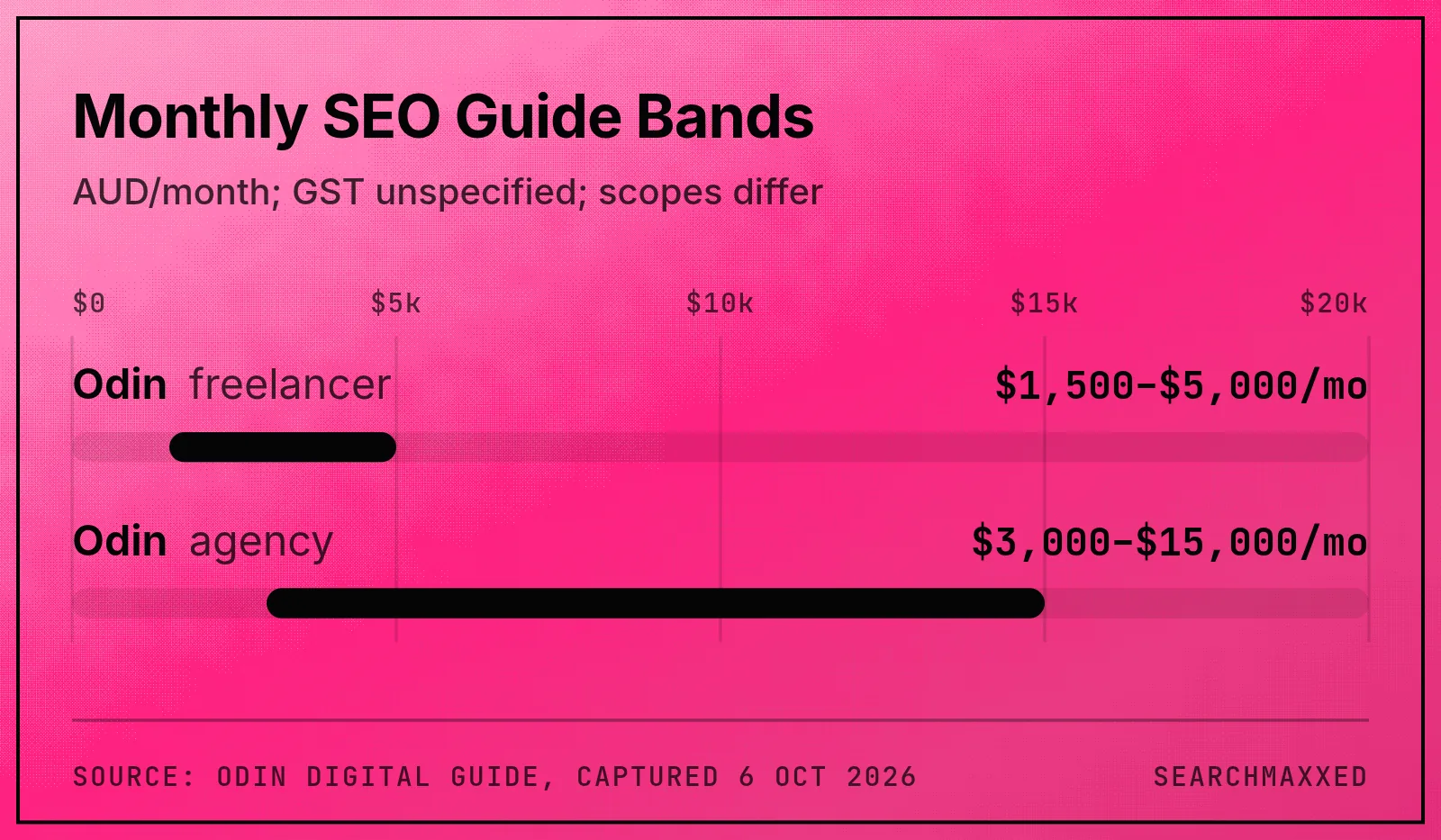
Odin Digital's Australian SEO guide publishes freelancer rates of $80-$250 an hour and $1,500-$5,000 a month.[2] Its agency band is $3,000-$15,000 a month.[1] Use these as starting points for discussing scope, not as like-for-like quotes.
| Work model | Published guide band | What to clarify |
|---|---|---|
| Freelancer, hourly | $80-$250/hour | Hours, tasks and spending cap |
| Freelancer, retainer | $1,500-$5,000/month | Advice, implementation or both |
| Agency, retainer | $3,000-$15,000/month | People, outputs and exclusions |
Source: Odin Digital, Australia, checked 6 October 2026; currency AUD; tax treatment unspecified.[2][1]
If a freelancer and an agency quote the same amount, compare their scope. Ask who writes the page and who fixes the code. Ask who checks the enquiry form after release.
For hourly work, agree on the task and a spending cap. For a fixed project, define the finished output and acceptance checks. For a retainer, agree on recurring work and how priorities can change. I'd choose the billing model after defining the job.
What should you include beyond the invoice?
Budget for the whole job: the provider, your time managing it, any separate writing or development, and tools outside the quote. Matebiz notes that freelance arrangements can still need client direction, approvals and coordination.[4]
Compare the full annual employment cost with twelve months of agency fees. Include superannuation, recruitment, tools and outside specialists. Check whether you have enough ongoing work to fill the role.
For DIY, reserve time for learning, production and checking changes. Treat paid tools as separate choices. Start with a task you can finish before buying more software.
The same exercise applies to every model. Ask for a written division of work, including the jobs you must do yourself. My Australian SEO cost guide covers the wider budgeting decision.
Which option has the skills you need?
Choose a freelancer for a specialist gap and an agency when you need several people working to one plan. Test the actual people either way. Invoke Media argues that a specialist SEO freelancer can outperform an agency generalist.[5]
Odin names technical SEO and content strategy as examples of freelancer specialisms.[6] I would ask candidates to explain a problem on your site and the steps they would take to fix it.
Use the same interview topics across the options:
- For technical SEO, ask who can diagnose the fault and change the site.
- For content strategy, ask which customer question deserves a page and why.
- For local SEO, ask who will manage your business profile and review work.
- For link building, ask which outside sources fit your business and how they will check the work.
For an in-house role, write down the skills you need before choosing the job title. If the role needs specialist development or writing, provide that support. For DIY, be clear about which tasks you can review and which need another pair of eyes.
Ask about subcontractors too. Odin notes that freelancers may outsource parts of the work.[6] I'd put that question to an agency as well: who will do each job, and can you speak to them?
For AI search, ask for a demonstration of the proposed work. Our AI SEO explanation sets out how we connect research, pages and follow-up checks. Judge a provider on those actions, not on how often they say AI.
Which gets SEO work done faster?
At Searchmaxxed, I judge SEO delivery speed by when we can publish and check the first agreed change. Ask each provider for that date before committing. Keep the delivery deadline separate from any prediction about rankings or enquiries.
For a freelancer, ask about current capacity and what happens during an absence. For an agency, ask which people have time for your account. For in-house, confirm access to whoever can approve and deploy changes. For DIY, book the work into your calendar.
I would test speed with a small piece of work. Ask the candidate to diagnose an issue, propose a fix and explain how they will verify it. Agree on who supplies access and who approves the change.
A provider can't finish your approval for you. Put your own decisions on the schedule alongside theirs, including access, product facts and copy approval.
Odin recommends a paid audit as a trial before a retainer.[7] I'd also ask how the audit's first recommendation will reach the live site. A diagnosis and a finished repair deserve separate dates.
In-house SEO vs agency: who keeps control?
I'd choose in-house SEO for daily direction inside the business, and an agency for agreed delivery across several skills. In either model, keep ownership and approval rights explicit. Decide who can change the site, who can approve the work and how you will leave.
Before Searchmaxxed, I built Radiant Roof Repairs from zero to more than $1 million a year using SEO as the only marketing channel. I did the pages, research, competitor checks and updates manually.
That experience is why I ask who will do those jobs when comparing a hire. You can inspect the historical work in the Radiant Roof Repairs case study.
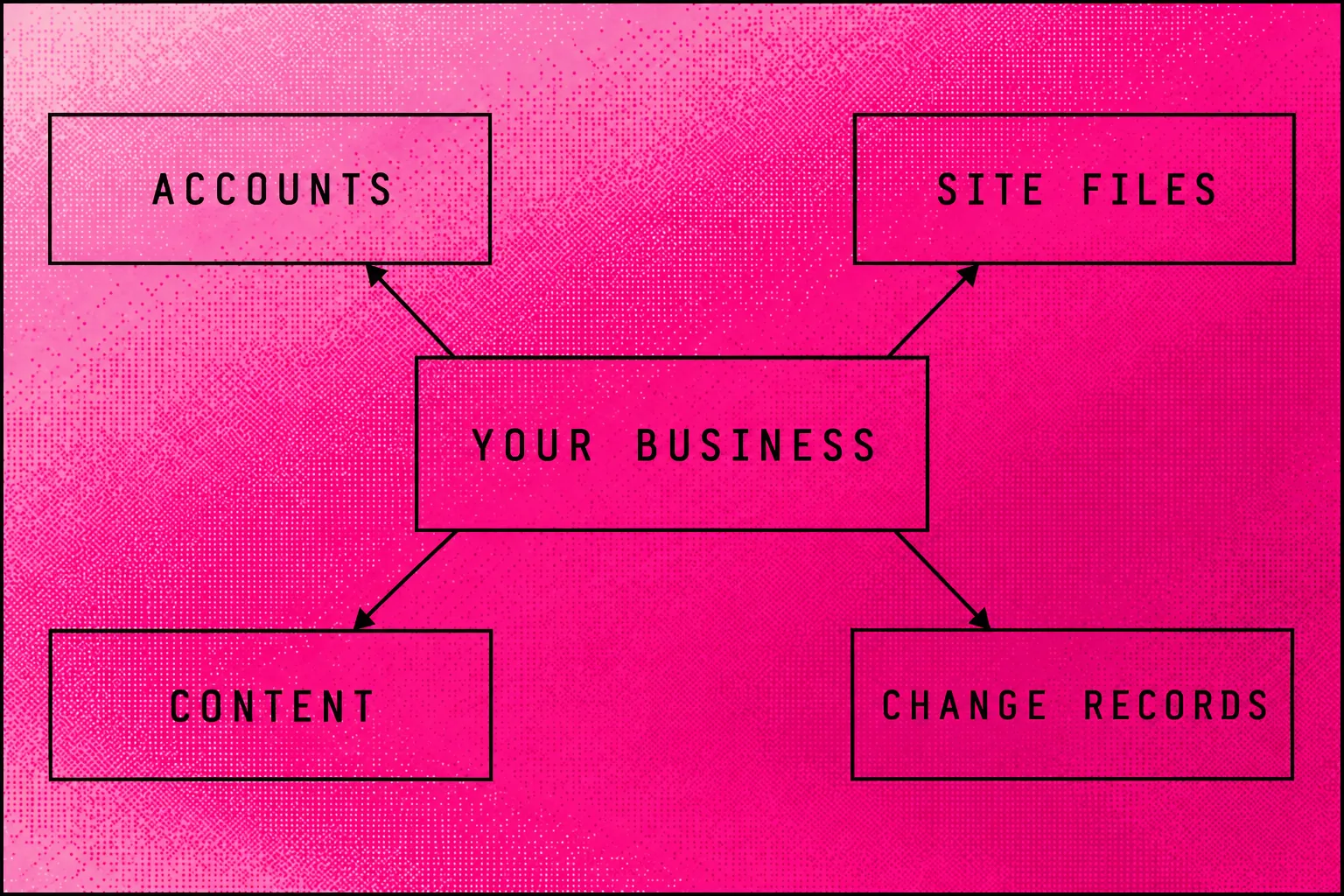
For your business, I would keep the domain, website accounts and analytics under your control. Give each person the access their task needs. Agree on how you receive the content, change records and source files when the arrangement ends.
An internal hire still needs a clear handover. Ask them to keep the plan and change history somewhere the business can access. Put the same requirement into a freelance or agency agreement.
Should you hire SEO help or do it yourself?
Do SEO yourself if you can learn the work, make changes and review what happened. Hire help when a skill gap or lack of time blocks those jobs. I'd start DIY with a clear customer question and bring in a specialist when you can't finish the next step.
Google says SEO can help when you apply it to people-first content.[8] Its content questions also ask for original information and value beyond rewriting other sources.[9] I would make that your writing test before adding more pages.
For a practical DIY trial, choose a service you already sell. Open its Search Console data and compare the customer questions with the existing page. Check your GA4 enquiry tracking, then decide what you can improve and how you will judge it.
Add the details you can support from your own business: what the service includes, where you provide it and what happens after an enquiry. Check the page and the form after publishing. Keep a record of the change and return to the same data when reviewing it.
If you can research and write but need help with code, commission that part. If the work keeps slipping behind customer jobs, consider someone with time assigned to delivery.
My preference is to learn enough to judge an SEO recommendation even when you pay someone else to implement it.
How do you reduce the risk of a bad hire?
Reduce hiring risk by agreeing on scope, testing a small job and protecting your access before expanding the work. Put the same questions to every SEO provider. I would use these six checks, whether you're interviewing an employee, a freelancer or an agency.
- See relevant work. Ask what the person changed, what happened next and how they connected the two.
- Name the people. Meet whoever will research, write, build and review your changes.
- Define the output. Agree on what you receive and which jobs need another supplier.
- Plan approval and repair. Set approval rights and ask how they would undo a harmful change.
- Keep access and records. Confirm ownership, cancellation terms and handover before starting.
- Judge business progress. Ask to see enquiries alongside search data and completed work.
For DIY, use the same checks on yourself. Keep the change small enough to review. Seek help before a change you can't safely reverse.
I would ask any provider to walk through a recent piece of work. Start at the reason for the change and finish at the live page. Ask what they would do next if it brought traffic but no enquiries.
Can an in-house person work with an agency or freelancer?
Yes, an in-house lead can set priorities while an agency or freelancer supplies missing skills and production time. Invoke Media describes agency oversight working alongside internal execution and specialist freelancers.[10] I'd choose the split by the job each person can complete.
For example, you could keep product knowledge and approval with your marketing lead. Hire a technical freelancer for a defined site problem. Give an agency the page research and delivery work your staff can't cover.
Write down who chooses the next job, who builds it and who approves it. Agree on one place for the plan and change history before adding suppliers.
If you hire a consultant for advice, name the person who will implement it. If your agency handles implementation, tell your staff which facts and approvals the team needs from them.
Choose a hybrid because it fills a gap you can name. Avoid adding another supplier before deciding who directs the combined work.
Where does Searchmaxxed fit?
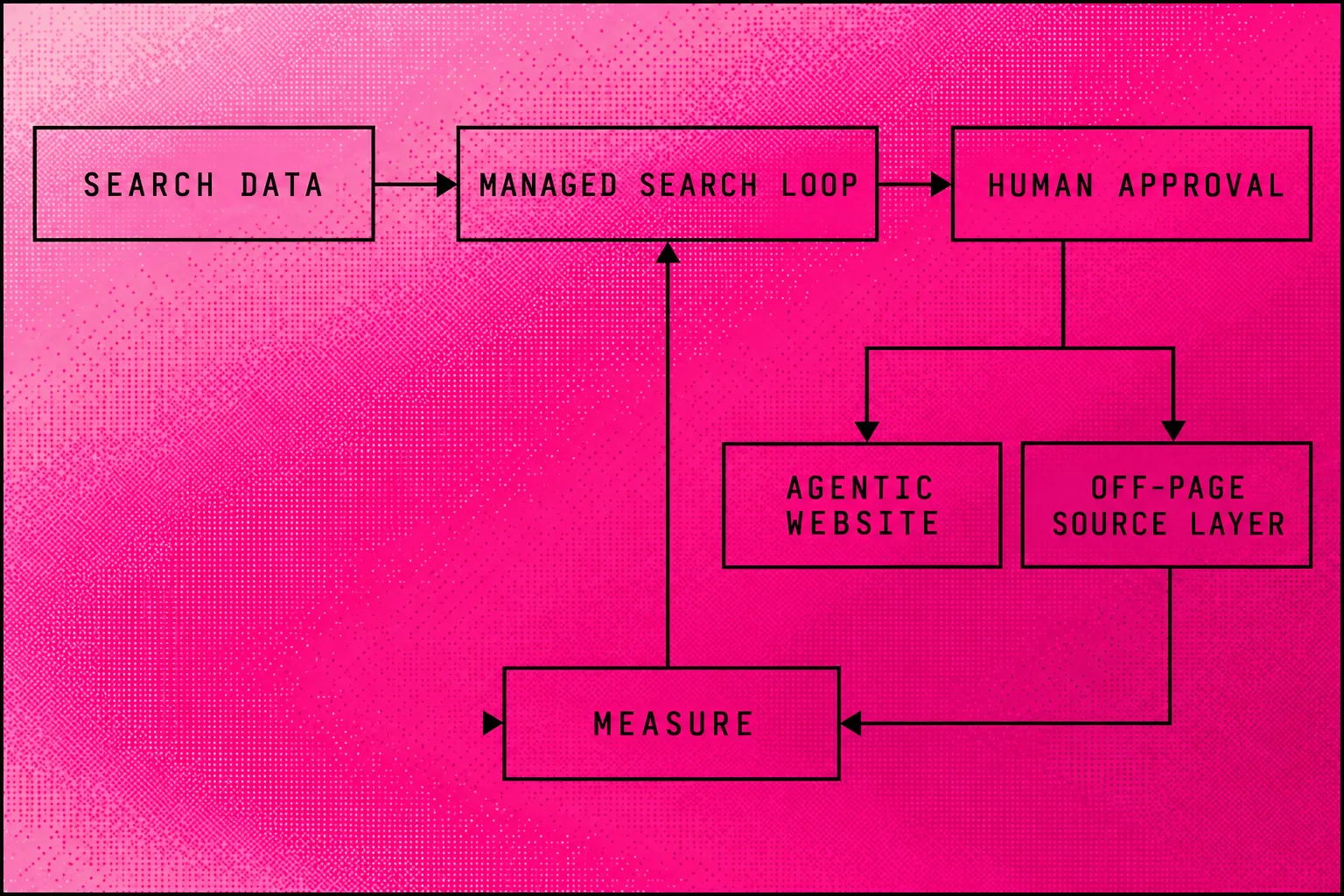
Searchmaxxed fits when you want a team to run agentic SEO: AI agents help research and measure while people approve the work. We build your Agentic Website. Our Managed Search Loop chooses the next job. Our Off-Page Source Layer builds support on other sites.
We connect the agents to your whole Search Console and GA4. Every week, they scrape competitor sites, read Google results and check what AI answers say about you. Our team reviews the evidence against your plan and selects the work.
We build pages and fix the site on your Agentic Website. It lives on GitHub and Vercel, and you own it. The work includes schema, which labels page facts for search engines, and links between related pages.
Our Managed Search Loop turns those checks into the next release. A person approves each change before it goes live. Then we check the live page and measure what happened before choosing the next job.
The Off-Page Source Layer handles links, reviews, citations, press and mentions on other sites. We connect the real business name, people, services and places so the website and outside records agree.
Our managed work includes AEO for the questions answer engines respond to. It also includes GEO for how AI answers describe your business.
I ran the same research, page and update steps by hand at Radiant Roof Repairs. Agents now assist those steps each week; the Radiant result came from my manual work. Across our client book, our work has generated more than $10 million in revenue through search. That's my cumulative client figure.
Which package covers the work?
Choose the scope after looking at your site, market and goals. Our package inclusions separate local work from wider page production and source work.
| Package | What it includes |
|---|---|
| Local Search | Local pages, business profile management, reviews, local links and listing cleanup |
| Growth System | Page releases, landing-page work, technical fixes, source work and AI tracking |
| Agentic Search Engineering | Growth System plus comparison pages, industry pages, digital PR and link campaigns |
| Custom & Enterprise | Agreed market coverage, engineering, reporting and original research |
For a new site, the Agentic Website Full Build includes market research, site structure, design, technical SEO and measurement. Agentic Migration keeps a design worth keeping and moves the site to an owned repository. The AI SEO Audit diagnoses gaps and sets out the fixes and plan.
If you need a single specialist job, I'd compare a freelancer. If you want to run the work internally, choose the people and support that make that possible. If you want us to run it, Let's talk pricing.
Frequently asked questions
How much does an SEO agency cost?
Odin Digital's Australian guide gives an agency band of $3,000-$15,000 a month, with enterprise work potentially higher.[1] Ask for an itemised scope before comparing it with another quote. The guide band does not set Searchmaxxed's fee.
Do I need an SEO agency?
You don't need an agency if you can plan and complete the work yourself or with a specialist. I'd choose an agency when the job needs several skills and you want the team to handle delivery. Ask who will implement each recommendation.
Is AI replacing freelancers?
AI assistance wouldn't remove my need for someone to judge and approve SEO work. Google discusses AI-assisted content and explaining automation's role.[11] It also warns against automated content whose primary purpose is manipulating search rankings.[12] Ask a freelancer how they check the work their tools produce.
How much do freelancers charge for SEO?
Odin Digital publishes Australian freelancer guide bands of $80-$250 an hour or $1,500-$5,000 a month.[2] Ask whether the quote covers an audit, advice or implementation. Agree on a spending cap for hourly work and a clear output for a project.
How much does it cost to hire an SEO expert?
How much does it cost to hire an SEO consultant?
For freelance SEO, Odin's Australian guide gives $80-$250 an hour.[2] For a consultant, I'd request a quote for the advice you need. Ask whether they will implement the recommendations or hand them to your team.
Is it worth it to hire an SEO expert?
I'd hire an expert when they can finish important work you can't complete with your current skills or time. Ask them to identify the obstacle and show how they would tackle it. Judge progress against completed changes and enquiries, with the full cost of the work in view.
What should I own when an SEO contract ends?
Ask to retain your domain, website, content, analytics access and change history. Put the handover in the agreement before work starts. At Searchmaxxed, you own the site, repository, content and data from day one.
Can I start with a freelancer and hire an agency later?
Yes, I'd start with a freelancer for a defined job and revisit the model when the scope changes. Keep the brief, findings and change records accessible to whoever takes over. Agree on the handover while you still have direct access to the person doing the work.
Can my in-house team run the Managed Search Loop?
Yes, you can run SEO and AI work in-house without a retainer. Searchmaxxed's Managed Search Loop connects evidence with the next job and follow-up measurement. If we operate it for you, our team handles the agreed work and approves public changes.
- Odin Digital: https://odindigital.com.au/blog/seo-freelancer-vs-agency
- Invoke Media: https://invokemedia.co.uk/the-difference-between-a-marketing-agency-and-a-freelancer-and-when-to-use-each
- Matebiz: https://www.matebiz.com/blog/agency-vs-freelancer-digital-marketing-2026/
- Google Search Central: https://developers.google.com/search/docs/fundamentals/creating-helpful-content